




🌍 Introduction
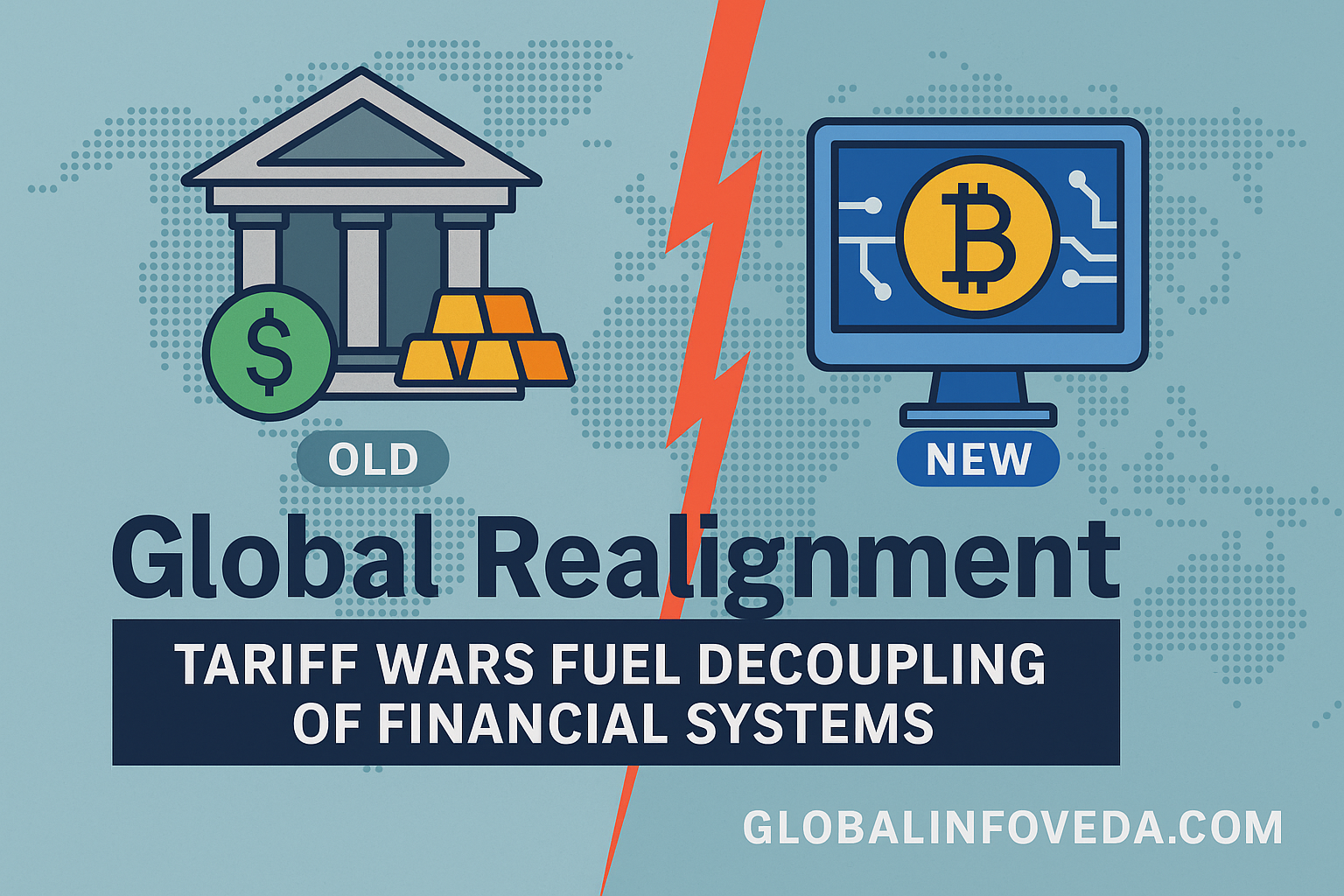
The 2025 trade wars have unfolded well beyond the walls of customs houses and supply chains. They have sped a visible, global realignment in the way money flows, in how payment systems interconnect and in who establishes the rules for financial stability. When a country imposes new duties, the first-order effect is clear — prices and trade volumes shift. The second-order effect is less noisy, but vastly more significant: banks reconsider correspondent relationships, treasurers re‑map FX exposures and governments construct alternative rails to hedge against sanctions and policy surprises. In that regard, the tariff wars of today are fueling financial decoupling—a slow, path‑dependent divorce of liquidity pools, standards and settlement pathways. India is somewhat at the heart of this transition, plugged into the dollar system while also rolling out payments systems along UPI corridors, CBDC pilots and IFSC infrastructure. This deep-dive will explain what’s changing, why it matters for households and firms, and how India can use the moment to upgrade resilience without sacrificing openness.
Meta description: Tariff turmoil is reshaping money flows. How financial decoupling unfolds, what risks it brings, and the pragmatic playbook India can run in 2025.
🧭 What “decoupling of financial systems” really means
The term financial decoupling might sound abstract, but in reality it refers to a collection of concrete shifts that alter incentives and plumbing. First, that means the rise of fragmented payment networks in parallel — some linked to the dollar, others only to regional currencies or CBDCs — with limited interoperability. Second, it encompasses new compliance regimes and data‑sharing requirements that break up cross‑border flows. Third, it is changing the marginal cost of moving value: If a company has higher due‑diligence friction on a traditional correspondent bank line, the firm might like a newer, more programmable rail even if the network is smaller today. Ultimately, it also affects portfolio construction: central banks diversify their reserves, corporates hedge in more currencies and families allocate their portfolios differently between deposits, gold and market instruments. None of this happens overnight. But tariff escalations force system actors to ask hard questions early, and the answers configure architecture for a decade. India’s strategic opportunity is to still retain that trusted node-ness across blocs, and while building autonomy in domestic rails, and settlement and risk management.
🧩 The chain reaction from tariffs to money markets
- 🔗 Price wedges → working capital stress: Higher duties widen landed‑cost gaps; retailers resist breaking price pegs, so suppliers carry longer receivables. Banks then tighten trade credit, raising financing costs across clusters.
- 🌐 Sanctions adjacency → compliance de‑risking: When tariff politics overlaps with sanctions debates, global banks reduce exposure to regions/products viewed as high‑friction. That shrinks correspondent capacity right when exporters need it most.
- 💱 FX volatility → collateral calls: A jumpy rupee or euro against the dollar triggers margin calls for hedged exporters; treasurers re‑price forward books and seek more granular hedges.
- 🧰 Alternative rails → routing experiments: Firms test instant‑payment corridors, bilateral settlement in local units, or CBDC pilots to bypass choke points. Early adopters accept setup frictions in exchange for reliability.
- 🧮 Portfolio shifts → liquidity fragmentation: Central banks and funds reweight reserves and mandates, thinning the market depth of once‑dominant instruments and raising the cost of large, fast moves.
🧮 🗺️ Mapping the arenas where decoupling shows up
| 🧠 Domain | 🚧 Where frictions rise | 🔧 India’s lever |
|---|---|---|
| Payments & settlement | Correspondent risk, sanctions screening, data‑localization debates | UPI international links, IFSC clearing, CBDC pilots |
| Capital markets | Access to dollar funding, custody interoperability, listing norms | Masala bonds, GDR/IFSC venues, robust CCIL risk tools |
| Standards & data | KYC/KYB, AML/CFT divergence, privacy vs portability | Account Aggregator, consent‑based data, interoperable APIs |
🌏 Why this moment is different from past trade spats
Conventional trade frictions corrected prices up or down, but the rails remained relatives. Tariff wars are taking place today in the context of three structural changes. One, real‑time payments have made alternative networks viable for commercial use – when an Indian traveller can send UPI in seconds to a partner corridor abroad, the proposition of value for small commerce and tourist flows changes. Two, digital identity and consent frameworks — from India’s Account Aggregator to comparable models in other countries — make it possible to port verified data across service providers, helping to enable open finance while maintaining user control. Three, the rise of programmable money — whether through CBDCs or tokenized deposits — allows compliance logic and settlement instructions to travel with the transaction, reducing disputes and making netting more efficient. These technological moves, piled on top of politics, speed up financial decoupling without the need for a single speech asking for it.
🧠 How India’s economy is exposed—and insulated
India’s access to the dollar funding channels for trade invoicing, oil imports and portfolio flows is still meaningful, so rupee stability continues to hang on to credible macro policy and strong reserves. But India has its own special kind of insulation: a vast and growing domestic market, an expanding public digital infrastructure stack and a more diversified export mix, including services, not just goods. India could cushion some pain by deepening EU, GCC, Japan and Asean corridors, while incorporating traceability and standards that raise switching costs for buyers, as tariff wars rewire trade patterns. With households, high inflation pass-through from imported input spikes is real; but take-up of UPI/RuPay/Aadhaar-enabled flows have kept domestic transaction costs at bay, sustaining consumption even in shaky external contexts.
🧰 The playbook for policymakers—plumbing before politics
- 🏦 Liquidity where it counts: Keep FX markets orderly with two‑way liquidity; enable banks to discount trade bills so export clusters don’t freeze.
- 🧾 Paperless borders: Expand e‑CoO, risk‑based inspection, and AEO recognition so compliant firms clear faster even when geopolitics heats up.
- 🛰️ Standards diplomacy: Align KYC/AML templates and data‑transfer protocols with trusted partners to ensure portability without losing sovereignty.
- 🔌 IFSC scale‑up: Grow clearing, trade credit insurance, and invoice discounting at IFSCs so risk gets priced by markets, not moods.
- 🧪 CBDC pilots with purpose: Test cross‑border CBDC corridors for small tickets, where friction is highest, and evaluate programmability for conditional payments.
🛠️ Treasurers’ toolkit—what resilient cash management looks like
- 💱 Hedge in micro‑layers: Rather than one big forward, layer 10–15% of exposure weekly; it lowers timing risk when tariff wars spike volatility.
- 🧮 Multi‑currency receivables: Encourage buyers in EU/Japan to invoice in EUR/JPY where feasible; match with input sourcing in the same currencies.
- 🧾 Netting & pooling: Use in‑house banks or fintech netting tools to settle intercompany flows; reduce external FX needs.
- 📊 Dashboards that matter: Track DSO, first‑pass yield, and return provisions; these signal whether decoupling is hitting operations, not just headlines.
- 🧰 Contingency rails: Pre‑board vendors on instant‑payment corridors and card‑not‑present backups; when one path fails, the other must work.
🧠 The geopolitics of standards—compliance as strategy
Privacy standards, A.I. safety standards, cybersecurity standards, sustainability standards are no longer the nerdy auxiliary; they are the pulling on levers. A trust market for your traceability is a market that buys more at a higher price. For Indian exporters, being in the vanguard on REACH/RoHS, ESG disclosures, and AEO translates into early financial benefits: less random inspections, speedier customs clearance, and improved working‑capital cycles. At a systemic level, India’s drive for interoperable consent frameworks enables fintech and banks to compete on user experience without dividing data. The more tariff wars convey that trade policy is untrustworthy, the more firms will pay for predictability, and standards are the cleanest way to sell it.
🧪 Case story — an exporter’s pivot to resilient rails
A mid‑sized home‑textiles company in Panipat saw American orders drop, and dollar receivables stall as bank compliance grew stricter. Rather than run down every work-around, the CFO made three moves. Dual‑spec SKUs, in the first place, permitted European buyers to keep the responsibility of retail pegs without margins being eviscerated. Second, an IFSC-based receivable-discounting line ensured cash cycles continued when a foreign bank suspended limits. Third, the company tested a UPI‑linked collection flow for smaller EU distributors through a partner PSP – reconciliation improved and chargebacks dropped. A year later, we saw €1 billion or 2% of market share fall into the hands of the EU, DSO dropped by nine days and the first‑pass yield went up by 30% as less rework was pushed through to hit unpredictable shipping windows. The takeaway: When it comes to financial decoupling, boring, disciplined plumbing has its rewards.
🧪 Case story — a fintech’s cross‑border corridor
A payments startup created a remittance and small‑merchant corridor between India and a GCC partner by connecting instant‑payment rails on each end. Instead of leading with crypto, the team led with compliance analytics, real‑time AML scoring, and name‑screening. Per-transaction costs declined, settlement risk was reduced and participating SMEs had working‑capital breathing space. The local economies were insulated from the goods volatility as tariff wars jostled shipping costs; merchants selling services — design, coding, consulting — kept cash flowing on this corridor.
📊 🔁 Parallel rails at a glance
| 🛰️ System | 💡 What it enables | 🇮🇳 India’s stance |
|---|---|---|
| UPI + partner links | Low‑cost retail flows, tourism spends, SME collections | Expand corridors; keep consent+security standards high |
| CBDC (pilot) | Programmable settlement, conditional disbursals, potential cross‑border tests | Test small‑ticket B2B/B2C; focus on interoperability |
| IFSC clearing | Market‑based pricing for trade credit and forex | Grow market depth, invite global insurers |
🧠 Households: protecting savings in a world of bifurcated liquidity
As liquidity pools disintermediate, retail savers encounter new trade‑offs. Bank deposits are safe, but may underperform inflation if rates fall in aid of growth; equities are exposed to drawdown if global funds rebalance on political lines; gold is a volatility sponge, and doesn’t generate a yield. “For Indian families in 2025, the most common sensical mix could be SIPs in quality funds, short duration debt for stability and some allocation to gold funds,” he says. Keep your hands off the leverage and the exotic structures that tout themselves as easy arb. On the payments front, favour UPI and RuPay with powerful consent trails and beware of fly‑by‑night wallets that pledge cross‑border magic without clear KYC. The north star is liquidity on demand — the ability to get to money when time is of the essence, and not an illusion of high returns.
🧠 Banks and NBFCs: underwriting in the age of fragmentation
For lenders, tariff wars and financial decoupling are changing underwriting in three ways. First, cash‑flow volatility increases for exporters dependent on a few buyers; scorecards now need to factor in not just a customer’s concentration but its DSO variability more than ever before. Second, FX managing capability is a proxy for governance; MSMEs that hedge in micro-layers and disclose hedge policies transparently are to be offered better terms. Third, sector pick is key: companies hung up on domestic consumption or EU/Japan alternates will appear safer than the knot welded to a single tariff-sensitive SKU. NBFCs integrating the pipes of data into GST, Account Aggregator, and e‑invoice streams will underwrite faster and cheaper, turning the advantage as banks remain cautious.
🧪 Case story — logistics as a balance‑sheet instrument
Most margin erosion, it turned out, was not in the product but in the container, the seafood exporter from Andhra Pradesh found. The company increased container fill by 12% and reduced dwell time at port by collaborating with nearby processors to establish a shared‑freight consortium, re‑engineering the cartons to reduce volumetric weight, and timing pickups with a milk‑run schedule. A local bank added an invoice-discounting line, despite sector headwinds, because it was swayed by the operational evidence. Here, financial decoupling demanded a change in habits—starting to think about logistics as belonging within treasury.
🧠 The role of messaging—credibility is a currency
Most margin erosion, it turned out, was not in the product but in the container, the seafood exporter from Andhra Pradesh found. The company increased container fill by 12% and reduced dwell time at port by collaborating with nearby processors to establish a shared‑freight consortium, re‑engineering the cartons to reduce volumetric weight, and timing pickups with a milk‑run schedule. A local bank added an invoice-discounting line, despite sector headwinds, because it was swayed by the operational evidence. Here, financial decoupling demanded a change in habits—starting to think about logistics as belonging within treasury.
🧠 Education, talent, and the compliance dividend
The scale edge that India enjoys becomes a sustainable edge only if accompanied by a compliance edge. That’s going to require talent: auditors who know REACH, engineers who can design for RoHS, lawyers who understand export controls, the product managers who can embed privacy in features. Modernizing polytechnics and apprenticeships around quality systems is not a side line — it is a competitiveness strategy. Companies that regard standards as product features and train on them gain access, pricing, and loyalty in risk‑adverse markets. Amidst the lunacy and chaos of the world outside, anxious markets pay for predictability; the ability to deliver that is India’s best moat.
🔭 Scenario planning—three paths and what changes in each
- 🟢 Easing: Limited carve‑outs or quota windows restore stalled SKUs; rupee stabilizes; banks relax trade credit. India prioritizes standards reciprocity and expands UPI corridors for retail resilience.
- 🟠 Sideways: Duties hold; order cycles shorten; treasurers rely on rolling POs and micro‑layered hedges; firms deepen EU/Japan ties and push IFSC tools.
- 🔴 Escalation: Duties widen; export controls harden; cash firewalls and credit insurance become lifelines; CBDC pilots for small cross‑border settle gain urgency.
🧮 📈 Portfolio defense—simple hedges for complex times
| ⚠️ Risk | 🌾 Natural buffer | 🧰 Instrument |
|---|---|---|
| Imported inflation | Gold, domestic demand exposure | Gold ETFs, short‑duration debt |
| Dollar funding squeeze | EUR/JPY receivables, local‑currency sourcing | Multi‑currency forwards, netting |
| Equity drawdown | Quality factor, cash buffers | SIPs staggered, protective puts |
🧠 Common mistakes firms make—and how to avoid them
- ❌ Heroic single hedges: A giant one‑off forward feels decisive but backfires when FX whipsaws; micro‑layer instead.
- ❌ Grey‑route fantasies: Third‑country workarounds invite rules‑of‑origin scandal and reputational scars; invest in compliance and documentation.
- ❌ Capex before throughput: In a fragile year, squeeze first‑pass yield and carton science before ordering new machines.
- ❌ Silence with lenders: Banks price uncertainty; weekly DSO/order‑book updates keep limits alive.
🧪 Case story — when design, not discounting, saves the line
A cookware supplier facing U.S. cancellations designed a value spec with thicker bases and a premium spec with scratch‑resistant coating, both using redesigned cartons. A European home chain accepted the twin‑spec logic, holding price points without eroding brand. Returns fell, first‑pass yield rose, and cash conversion improved—proof that financial decoupling doesn’t mean racing to the bottom; it means making quality legible.
🧠 What success could look like by 2026
If India delivers effectively, the country can expect to see AEO firms clearing in hours by next year, measurable expansion in IFSC‑based trade finance, UPI spending by tourists on partner rails and CBDC pilots moving up from trials to targeted corridors. Export clusters will display traceability dashboards with pride, women’s representation will stabilise in knitwear due to crèches and safe commutes, and corporate disclosures will throw up DSO and return‑provision discipline. Most tellingly, the rupee will trade in more muted bands even if global noise reappears, reinforcing that financial plumbing — not empty rhetoric — is at work.
❓ FAQs—clear answers for decision‑makers
Is “de‑dollarization” the right word? Not really. Global trade still clears largely in dollars. What’s changing is diversification: more EUR/JPY/CNY invoicing at the edges, plus CBDC experiments. Think of it as risk‑management, not ideology.
Will parallel rails make commerce slower? In the short run, fragmentation adds friction. But well‑governed instant‑payment links and IFSC risk markets can restore speed while lowering single‑point dependency.
Should MSMEs bother with hedging? Yes—especially now. Micro‑layered forwards and clear hedge policies often make the difference between survival and distress when invoice timing slips.
Are CBDCs a near‑term fix? Only for specific use‑cases: small cross‑border invoices, conditional disbursals, or high‑friction corridors. The priority is interoperability and clean compliance hooks, not novelty.
How do households avoid scams during volatility? Stick to regulated rails—UPI, bank apps, RuPay—with strong consent trails. Ignore offers that promise cross‑border magic without transparent KYC and dispute resolution.
🧠 Personal analysis—why calm plumbing beats loud posturing
The temptation in crisis is to look for a silver bullet — a headline-grabbing solution that can provide instant reassurance to all. Meanwhile, the actual work is tedious: AEO application, e‑CoO uptake, FX micro‑hedges, carton re-engineering and IFSC depth. But dull wins. Compound, which is the nearest thing in finance to a magic formula, is only possible because the improvements are incremental. In a world where tariff wars are driving systems toward financial decoupling, the countries and companies that out‑execute on plumbing, not press releases, will capture the trust dividend. India must be that execution story if policy is predictable, data‑rich, and single-mindedly focused on throughput.
📚 Sources
- Reserve Bank of India (RBI) — External sector & market developments; payments and settlement updates: https://www.rbi.org.in/
- Bank for International Settlements (BIS) — Analyses on cross‑border payments, CBDCs, and market structure: https://www.bis.org/
- International Monetary Fund (IMF) — Global Financial Stability Reports and FX market assessments: https://www.imf.org/
- SWIFT — Messaging standards and cross‑border payment Modernization notes: https://www.swift.com/
🌟 Final Insights
The wave of tariff wars is not merely a playground battle over customs lines but a forcing function for financial decoupling, which in turn will reimagine payments, settlement and the geography of liquidity. India’s advantage is the ability to serve as trusted node across systems and scale its own rails —UPI, IFSC and CBDC — to reduce friction and maintain trust. The pragmatic way forward is clear: invest in standards as product features, deepen risk markets at home, micro‑hedge exposures and publish data that attests to reliability. If policymakers, lenders, and companies remain disciplined, India can make a virtue of fragmentation, and grow in a more resilient way — with households protected, exporters competitive and investors anchored by credible plumbing.
👉 Explore more insights at GlobalInfoVeda.com