





🇮🇳 Introduction
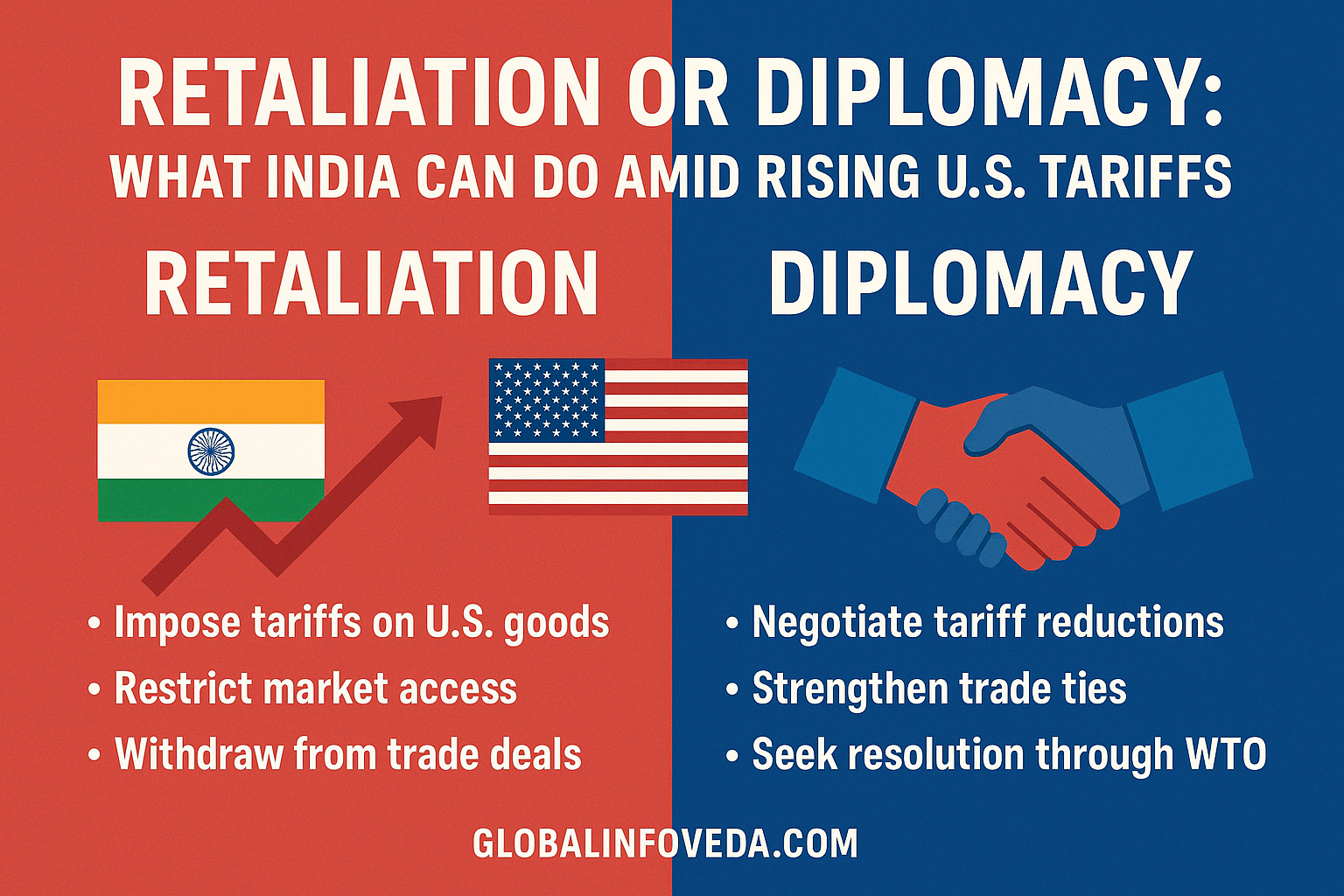
The 2025 US tariff war spike in the trade war has transformed a standard trade bickering into a stress test of India’s strategic autonomy. Beyond the headlines of increased duties and declining shipments, the true struggle is over control of leverage — who dictates the terms on which supply chains are run, technology is accessed and financial plumbing is organized. In that climate, knee‑jerk retaliations do feel emotionally satisfying, and patient diplomacy appears frustratingly slow. The fact is that India needs both, sequenced smartly. This playbook lays out how New Delhi can calibrate retaliation to avoid escalation, deploy diplomacy to reopen corridors and harden the economy with domestic reforms so that future tariff waves sting less. You’ll find policy options, sector tactics, legal pathways, negotiation scripts and real‑world case stories that translate grand strategy into factory‑floor reality — so India exports stay competitive even when the tide is tough.
Meta description: India’s response to U.S. tariffs—balance retaliation and diplomacy with legal routes, sector playbooks, and reforms that protect growth.
🧭 Strategic frame: choosing when to push, when to persuade
The first thing India must decide is not what duty to retaliate with, but what objective it wants to emphasize. Is it to send a signal of resolve, to give exporters time to reroute, or to reset rules in a way that will last beyond the current cycle? Sequencing matters. Front‑loaded retaliation on a limited range of politically salient imports — for which India has elastic alternatives — would provide quick bargaining chips without harming Indian consumers. In the meantime, good diplomacy will address HS‑line carve‑out, quota windows and mutual recognition of compliance and other measures that reduce friction over the longer term. The aim is to keep coalitions broad: trade partners in both the EU, GCC, Japan, and ASEAN who can act as shock absorbers for redirected flows and domestic stakeholders—MSMEs, women workers, logistics operators—who can ride the adjustment without leaving it permanently scarred. The success metric here is not a viral headline, but throughput, first‑pass yield and export invoices to keep a paycheck steady.
🎯 Decision tree for policymakers
- 🧩 Define the target function: Is the priority price stability, jobs, or strategic leverage? Rank them for the next 180 days and revisit monthly.
- 🛡️ Pick the pressure points: Choose imports where retaliation doesn’t spike domestic inflation—luxury goods, discretionary durables, or categories with multiple origins.
- 🚦 Set triggers and sunsets: Write sunset clauses and clear de‑escalation triggers (e.g., carve‑outs on HS lines, monitoring committees) to keep options open.
- 🤝 Build coalitions: Align with EU/Japan/GCC on compliance norms and AEO reciprocity so supply chains have places to land.
- 🧾 Legalize the road: Prepare WTO‑consistent filings (safeguards/anti‑dumping where appropriate) to avoid own‑goals.
- 📊 Publish dashboards: Weekly cluster‑level indicators—orders, hours worked, DSO, return rates—so policy can be tuned fast.
Context on global system shifts: Global Realignment—Tariff Wars Fuel Decoupling of Financial Systems
🛠️ Retaliation instruments India can deploy without self‑harm
An import more is one reason blanket retaliation so often boomerangs. The smarter design is surgical. One, reflect mirrored tariffs for products where India has a credible alternative or have little passthrough to CPI for example, select luxury items, niche appliances or be processed foodstuffs for which suppliers are many. Second, apply temporary safeguards where there is an obvious surge and domestic injury can be shown. Third, use standards enforcement (product safety, labelling, sustainability) in non discriminatory, WTO‑compatible fashion to slow down high‑risk inflows and improve consumer protection. Finally, think quantity, not just price — quota windows and licensing can meter flows without headline-grabbing duties. Each tool should be placed within a time‑boxed framework with review checkpoints, so India continues to be perceived as predictable even when it is firm.
Immediate market lens: Market Fallout—Trump’s Tariffs Send Rupee Weak, Shake Investor Sentiment
🤝 The diplomatic toolkit: how to reopen corridors faster
- 🧳 HS‑line diplomacy: Build data‑rich dossiers showing where U.S. consumers face visible price spikes; request carve‑outs or TRQ (tariff‑rate quotas) for those lines.
- 🧰 Mutual recognition: Pursue AEO reciprocity and paperless customs pilots with key partners to reduce dwell time and costs for compliant firms.
- 🧪 Quality grants: Co‑fund exporters’ REACH, RoHS, and traceability upgrades to unlock EU/Japan access quickly.
- 🧭 Buyer missions: Run curated roadshows—pre‑booked meetings, translated catalogs, and cluster demos—in EU/GCC/Japan.
- 🛰️ Tech corridors: Expand semiconductor adjacencies (OSAT, IP blocks), battery recycling, and grid storage alliances enabled by standards alignment.
🧮 ⚖️ Comparison — retaliation vs diplomacy vs hybrid
| 🧠 Approach | 🎯 Immediate effect | 🔭 6–12 month outcome |
|---|---|---|
| Retaliation | Fast signal, bargaining chip | Risk of CPI pass‑through if mis‑aimed; tit‑for‑tat spiral |
| Diplomacy | Slower optics, corridor building | Durable access via carve‑outs, standards recognition |
| Hybrid | Signal + pathway in parallel | Balanced leverage, reputational gain if transparent |
🧑🏭 Sector playbooks—factory‑level moves that matter
Textiles & apparel: Guard retail pegs for buyers by creating value/premium dual specs per SKU, investing in digital prints and functional fabrics and presenting three‑pack bundles to maintain ASPs. Gems & jewellery: Diversify natural risks by promoting lab‑grown capsules and drive story‑led independents; protect QC to ensure returns don’t kill your slim margins. Seafood: Go to value‑added marinated/breaded formats and co‑design weekday portions with chains; let cold‑chain reliability be your calling card. Auto parts: Protect design-in slots with Tier-1s, co-fund validation and grow aftermarket SKUs in LatAm/Africa to smooth cash flow. Specialty chemicals: Provide alternate grades and formulation support; document compliance in a manner that makes switching costs very high to our competitors.
Deep India map of exposure: India Hurts—Sectors Under Pressure as U.S. Doubles Tariffs
🧰 MSME survival kit—cash first, leverage later
- 💱 FX discipline: Book small forwards in layers (10–15% weekly) so you never make a heroic one‑shot bet.
- 🧾 Receivable discounting: Spread across platforms; don’t let one lender’s mood freeze your book.
- 🛡️ Selective credit insurance: Cover your top 20 counterparties; fund QC upgrades with premium savings.
- 📦 Carton science: Reduce volumetric weight; pair with shared freight across cluster peers.
- 🧪 Throughput over capex: Use SMED and layout tweaks to lift capacity while cash is king.
🏛️ Legal pathways that reinforce credibility
India’s strength derives from being strong but predictable. What it calls for is working within those guardrails where possible to challenge China — filing safeguard or anti‑dumping actions only when injury is evident, not as a headline stunt. It also means using national law to facilitate compliance — to speed up paperless customs, digitalize Certificates of Origin and expand the number of businesses enrolled in the AEO system to minimize random inspections. With partners, drive mutual recognition — so a factory that clears a standard in India has its path cleared quickly at foreign ports. And when tariffs violate most favored nation principles — or procedural norms — be ready with dispute settlement methods, (not to showboat to the heavens), but to establish precedents that will sustain over time in which the law favors exporters. It’s credibility as a force multiplier in geopolitics.
📊 🌍 Comparison — corridors India can scale now
| 🌐 Corridor | ✅ What fits fast | ⚠️ Watch‑outs |
|---|---|---|
| EU | Home textiles, functional apparel, chemicals | REACH costs; energy volatility |
| GCC | Jewellery, seafood, homeware, fast fashion | Price sensitivity; USD‑linked FX |
| Japan/ASEAN | Auto parts, functional fabrics, electronics adjacencies | Certification time; high quality bar |
🧪 Case story—Tiruppur’s sprint to a German discounter
A knitwear MSME witnessed a 28% decline in U.S. POs after the US tariffs increased. The leadership convened a design pod, rebuilt tees with lighter GSM, beefed up seams and pitched a German discounter with OEKO‑TEX compliance and traceability dashboards. Jorwel had won shelf trials (as opposed to a winner-take-all race to run shared freight) when they were placed in two clusters, and two quarters later capacity utilization was back up to 85%. The lesson: diplomacy at buyer level works when you know that then language of standards and on‑time, in‑full.
🧪 Case story—Surat’s lab‑grown pivot and origin proof
A diamond house hedged its natural line with a lab‑grown capsule and shifted final polishing to a duty‑neutral hub. Virtual try‑on reopened U.S. independents; women polishers moved into QC roles, cutting defects. Employment held; U.S. dependence fell; India exports retained pricing power via story and compliance.
🧪 Case story—Kakinada seafood’s value‑added detour
A seafood processor co‑designed weekday portions and marinated/breaded packs for U.S. chains while redirecting to EU/GCC. Cold‑chain partners improved container utilization; farm exits slowed. When diplomacy is slow, spec agility is speed.
🧠 States’ role—where resilience is actually built
Downcycles are survived locally. Tamil Nadu and Punjab need creches and safe transport to retain women on knit floors; Gujarat can buffer gems/chemicals with engineering backfills; Andhra and the east coast must protect cold‑chain integrity so ponds don’t go fallow; Uttar Pradesh can lean into design for metalware/leather. States that back testing labs, host curated buyer meets, and publish cluster dashboards will keep jobs intact and shorten the pain.
🧰 Household lens—protecting family balance sheets
- 🧾 Budget resets: Recast spends for food, fuel, EMIs; plan for imported‑input bumps.
- 💳 Debt hygiene: Prepay high‑APR balances; avoid floating‑rate borrowing unless income visibility is strong.
- 🪙 Gold as volatility buffer: stagger entries; don’t lever.
- 🛒 Smart buying: Prefer repairable durables; watch combo offers, not just sticker price.
- 💼 Savings ladder: Keep 3–6 months liquid; ladder FDs to manage rate risk.
🧠 Negotiation scripts Indian firms can actually use
- 🗣️ To a U.S. buyer: “We can defend your peg with a twin‑spec: value for $9.99 and premium for $12.99. You keep shelf logic; we hold first‑pass yield. Let’s trial a 12‑week bundle and split the promotion budget.”
- 🗣️ To an EU buyer: “We’ve completed REACH and AEO; audits available on a live traceability dashboard. Approve a small curated drop; we’ll co‑fund packaging changeovers.”
- 🗣️ To a bank: “Here’s our weekly DSO, order book, and OTIF record. We’re rolling FX forwards in micro‑layers. Increase the receivable line by 10% for 90 days to bridge the cycle; floor walks welcome.”
🔮 Scenarios: 3 paths and what India should do in each
Easing: Carve‑outs/TRQs come for leading HS lines. Keep the powder dry for retaliation; push mutual recognition of standards and bring groups of buyers. Sideways: The tariffs stand; cut your ordering time frame, press rolling POs, protect clusters with creches, hostels and logistical help. Escalation: Duties broadened or export controls tightened; expand cash firewalls for payroll/utilities, trigger safeguards where injury is provable and lurch dispute settlement to set a standard.
🧮 📈 Comparison — policy tools, speed, and political cost
| 🧰 Tool | ⚡ Speed | 🧭 Political cost |
|---|---|---|
| Selective mirror tariffs | Fast | Medium—must avoid CPI flare‑ups |
| HS‑line diplomacy (carve‑outs/TRQs) | Moderate | Low—requires data and patience |
| Safeguards/standards enforcement | Moderate | Low‑medium if evidence is strong |
🧠 Communications: clarity beats cleverness
Crisis communication should be boring and precise. Announce objectives (jobs, price stability), metrics being watched (orders, hours, DSO), and sunsets for each intervention. Share cluster dashboards publicly to build trust. With foreign partners, keep messaging about predictability and standards, not grievance. With citizens, explain what relief is targeted, who qualifies, and when it ends. Clarity lowers risk premia and buys time for diplomacy to work.
💹 Financial plumbing—keeping credit flowing
When U.S. tariffs strike, the first macro victim isn’t GDP; it’s working capital. The RBI can fly into and out of FX windows like a superhero, preventing disorderly moves in the rupee; durable liquidity can be fine-tuned so the banks can continue to discount invoices and fund export credit. IFSC‑style hubs could accommodate supply‑chain finance platforms and credit insurance marketplaces; states could co‑fund testing labs and cluster logistics so that lenders can be confident of throughput. The theme is straightforward: preserve cash circles and first-pass yield, and the growth will come.
🕰️ Implementation timeline—180‑day sprint India can actually run
Days 0–15: Publish the objective stack (jobs, price stability, leverage), announce sunset clauses for any temporary measures, activate cluster dashboards in knitwear, gems, seafood, auto‑components, and chemicals. Convene a joint cell of commerce, finance, RBI, and ports to monitor rupee, DSO, and booking ratios. Identify mirror‑tariff candidates that don’t lift CPI; draft WTO‑consistent filings in reserve.
Days 16–45: Launch HS‑line diplomacy dossiers with price‑spike evidence for U.S. consumers and ask for carve‑outs/TRQs on top hit lines. Run the first buyer missions in EU/GCC/Japan with pre‑booked audits and translated catalogs. Expand AEO enrollment drives in clusters; pilot paperless customs in two ports with tightly defined SLAs. Mandate cash walls at large exporters to protect 90–120 days payroll and utilities.
Days 46–90: Roll out quality grants tied to milestones—REACH/RoHS testing, wastewater upgrades, traceability dashboards. Negotiate shared‑freight consortiums in textiles and seafood to improve container fill and shave per‑unit logistics costs. Publish weekly orders/hours/DSO to build credibility. If retaliation is needed, implement it surgically, communicate the sunset date, and state the de‑escalation trigger in one page.
Days 91–180: Convert the best EU/Japan/GCC pilots into annual frameworks; seek AEO reciprocity with two partners. Deepen IFSC‑based supply‑chain finance marketplaces so receivable discounting doesn’t freeze when risk premia rise. Table a standards reciprocity roadmap for cosmetics, toys, kitchenware, small appliances, and textiles, so compliance earned in India travels abroad without extra friction. Document case stories publicly to teach clusters what works.
🧠 Sanctions, export controls, and compliance hygiene
- 🧭 Know your web: Map where your BOM or cloud vendors touch sanctioned or controlled entities. Replace before a buyer finds it.
- 🧪 Data provenance: Keep dataset logs for AI‑adjacent exports; buyers will ask. Align with emerging AI safety evaluation norms so audits don’t derail shipments.
- 🧰 Licensing literacy: Train sales on when a simple spec tweak can tip a product into a controlled category. Maintain a quick‑reaction channel with counsel.
- 📜 Contracts that breathe: Add policy‑shock clauses, currency bands, and incoterm flex that allow rerouting without disputes. Archive all versions in a searchable DMS.
- 🔎 Audit rehearsal: Quarterly dry‑runs of REACH, RoHS, AEO, and CoO checks with third‑party auditors; fix the top 10 defects each time.
🏙️ City‑level relevance—what Indian metros can do next
Mumbai: Extend port gate hours during peak seasons; build a fast‑track lane for AEO exporters with predictable inspection slots. Mobilize local banks to enlarge invoice discounting pools for export clusters and publish average processing times weekly to shame laggards.
Delhi‑NCR: Host design pods where exporters prototype dual‑spec SKUs under buyer supervision; create a rolling calendar of buyer meets with EU/Japan and seed micro‑grants for packaging changeovers.
Bengaluru/Hyderabad: Stand up EDA/firmware bootcamps for electronics and auto‑component MSMEs; build shared traceability platforms for clusters so small firms can show big‑buyer‑grade dashboards.
Chennai/Coimbatore/Tiruppur: Fund testing labs and creches to retain women in knitwear; create cluster‑owned shared freight desks to consolidate LCL into FCL and negotiate better rates.
Surat/Morbi/Jamnagar: Build origin‑proof documentation clinics and virtual try‑on content studios for jewellery/brassware/tiles so independents in EU/U.S. can buy with confidence.
🧩 Myths vs facts decision aid for leaders
- ❌ “A weaker rupee fixes margins.” → ✅ It cushions dollar invoices but raises imported inputs and debt service; lock in savings via automation and compliance.
- ❌ “Standards are a cost centre.” → ✅ In 2025, standards are your sales deck; they unlock corridors and pricing power.
- ❌ “EU/Japan take too long.” → ✅ First approvals are slow; renewals are fast. Front‑load the pain once; then compound.
- ❌ “Retaliation must be loud to work.” → ✅ Surgical, time‑boxed retaliation with declared sunsets builds leverage and preserves reputation.
🧠 Extended FAQs for CXOs and policy teams
How do we choose what to retaliate against without hurting households? Pick imports with elastic alternatives and low CPI pass‑through. Simulate price impacts for the bottom income quintiles before notifying. Avoid essentials; favor luxury/discretionary where origin can switch.
Can we sustain jobs without blanket subsidies? Yes. Fund creches, hostels, and safe transport to retain women and migrant workers; co‑fund testing/traceability instead of open‑ended price supports. Tie aid to milestones so capacity upgrades outlast the downcycle.
What numbers should boards track weekly? Orders booked, hours worked, DSO, first‑pass yield, return provisions, and container fill. These tell you if playbooks are biting.
Does switching to EU/Japan dilute profitability? Not if you sell functional or story‑led ranges and build dual specs. Compliance costs are higher upfront, but renewals are quick and raise pricing power.
What if a buyer demands deep discounts instead of spec changes? Offer bundle logic (e.g., three‑pack) or limited‑run capsules with tighter QC to protect margins. If refusal persists, document and pivot to independents with origin story content.
Are we safe using third‑country finishing hubs? Only if rules of origin are respected and documentation is watertight. Grey routes will burn reputations in 2025.
Which financial hedges fit MSMEs? Small, rolling forward layers; avoid exotic structures. Consider protective puts around policy dates; finance with covered calls on slow‑moving inventory.
What’s the single highest‑leverage factory project? Lift first‑pass yield. It slashes rework, returns, and financing cost. Most clusters can gain 2–4 points within a quarter with basic process discipline.
🧰 Retailer reality—defending pegs without destroying brands
Indian exporters win when they address a retailer’s peg problem. It’s shipping twin-spec packs, value-added versions (marinated, pre-seasoned, pre‑bundled), and design refreshes crying out for ASP tiers. It also means packaging that minimizes volumetric weight and features modular inserts so one carton can accommodate multiple planograms. Present bundle ladders and share promotion budgets with warehouse clubs and discounters 12‑week trial plan. For department stores: push limited runs linked to stories — hand‑loomed, lab‑grown, recycled — verified through traceability dashboards. Reliability is the product; design is the hook; compliance is the moat.
🔎 Metrics that predict whether policy is working
- 📈 Orders/hours worked rising together across clusters for four consecutive weeks.
- 🧾 DSO compressing by 5–10 days as buyers regain confidence.
- 🔁 Return provisions shrinking; first‑pass yield rising after spec changes.
- 🚚 Container fill and on‑time, in‑full improving as shared freight kicks in.
- 💱 Rupee trading in narrower ranges despite global noise, indicating credible FX plumbing.
- 👩🏭 Women’s retention on shop floors stabilizing as creches/transport come online.
🧠 Personal analysis—why patience plus speed beats noise
This is the moment that prizes quick action and slow signalling. Rush on the factory floor — cartons, specs, dashboards — but talk slowly in public so your partners read seriousness, not panic. India’s edge is even scale with brains: clusters capable of delivering quality, compliance and volume and the ability to tell credible origin stories. If policy remains predictable, buyers will remain one foot, then two, inside Indian supply chains, even if tariffs continue to yo‑yo. That is the hard win: to be the one trusted node in a noisy world.
📚 Key references for policy and compliance
- Reserve Bank of India (RBI) — External sector and market bulletins: https://www.rbi.org.in/
- Directorate General of Foreign Trade (DGFT) — HS‑code policy and export facilitation: https://www.dgft.gov.in/
- World Trade Organization (WTO) — Trade policy monitoring and dispute process: https://www.wto.org/
- Office of the U.S. Trade Representative (USTR) — Tariff notices and consultations: https://ustr.gov/
🌟 Final Insights
India’s most intelligent response to U.S. tariffs marries retaliation and diplomacy with a third leg: dogged domestic upgrading. Use retaliation surgically where it accretes leverage without pumping nascent inflation; use diplomacy to win HS‑line carve‑outs, TRQs, and standards recognition; use the moment to accelerate compliance, traceability and design‑in capabilities that make India exports sticky across corridors. It will not show up in big noisy numbers.” Success for her will be in the silent cues — orders revived, hours worked, DSO contained, the number of women retained on the shopfloor, and a rupee that trades without drama. It is how India turns a shock into strategy — and strengthens resilience for the decade ahead.
👉 Explore more insights at GlobalInfoVeda.com