







🔍 Introduction
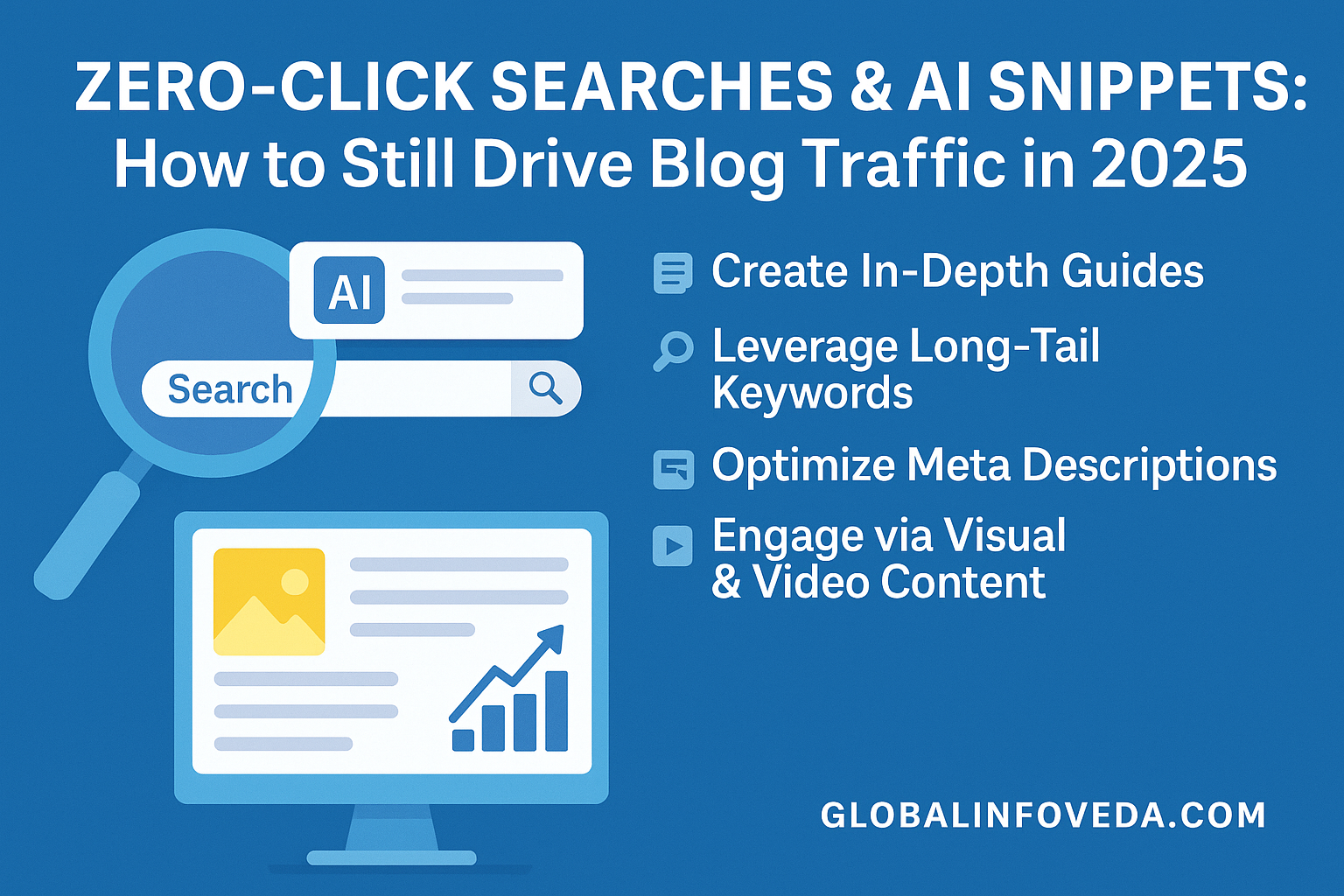
Zero click searches and AI snippets have redrawn the open web of 2025. Rather than dispatching users to publishers, the answersailing (from search engine AI summaries to chat-shop assistants embedded within browsers) resolves intent in situ. That doesn’t mean your blog is doomed, it means that your content strategy, data structure, and brand signals have to catch up. This year, the winners are content teams who design content to satisfy instantaneous intent while still capturing qualified sessions, subscriptions and conversions. This guide demonstrates how to construct click‑worthy edges in a space that values the fast, the trustworthy, the entity, and the useful over the click‑in itself, with specific Indian notes on voice search, multi‑lingual queries, and mobile‑first consumption.
Meta description: Navigate zero‑click and AI snippets in 2025 with entity‑first content, structured data, task tools, and brand defensibility—plus India‑specific voice and mobile tactics.
🧭 The new reality of search intent in 2025
Search intent is now broken apart into answer seekers, task doers and deep divers. AI layers are really good at the first two — they can summarise how‑to, definition and fact queries or even throw in fast unit conversions, dates and lookups. The deep divers are still won by being the place of record for the original research, the first‑hand examples, the calculators and the frameworks. Your editorial position should be that visibility inside snippets is stage one, and pull‑through to owned outcomes is stage two. This is not an exercise in “optimising for robots” but in representing knowledge such that machines can attribute and humans can act. If your piece does have the answer to micro‑questions, AI snippets will excerpt you; if your brand has the next-step thing — a download‑free tool, an email digest, a checklist, a bit of localised wisdom — the reader will still elect to click.
🧩 What zero‑click means for measurement
Sessions fall when it comes to commodity questions, though: qualified actions, yes, can rise when you build task surfaces readers actually want. Measure assisted value: newsletter opt‑ins, tool runs, FAQ views, time‑to‑answer instead of worshipping raw traffic. Think of snippet presence like ad impressions — evidence of mindshare that you weaponize with brand recall and retargeting. For India, a land of cheap mobile data and mixed‑language households, your content needs to resolve in 10–15 seconds and provide a tap‑friendly next step that doesn’t force me to experience desktop-style friction. That’s how you rebuild leverage when the pageview isn’t promised.
🧱 Foundations you can’t skip in 2025
- 🧠 Entity‑first architecture: define people, places, products, organisations, and concepts your site owns. Build hub pages that interlink definitions, FAQs, and use cases with clean schema and canonical URLs.
- 🧾 Structured data everywhere: FAQ, HowTo, Speakable, Product, and Dataset schemas feed AI snippets with validated facts and step lists.
- 🧪 First‑hand signals: original benchmarks, price trackers, case diaries, and field notes make you the source that aggregators cite.
- 🎛️ Task surfaces: small calculators, checklists, and configurators embedded above the fold keep users with you even when answers appear elsewhere.
- 🔐 Trust layers: transparent bylines, last‑updated stamps, evidence badges, and short author bios with credentials.
Answer Engine Optimization for AI Search Responses
🧭 Editorial patterns that feed AI snippets (and humans)
- 🧩 Atomic answers: one‑sentence definitions that are quotable, followed by a 2–3 line expansion and a visual cue.
- 🪜 Stepwise clarity: for any action, show numbered steps with verbs, inputs, and outcomes. Pair with HowTo markup.
- 🧷 Constraint notes: mention limits, exceptions, or regional rules so your summary feels trustworthy and is safer for snippets to use.
- 🧪 Micro‑evidence: add one stat, one date, or one source per section to anchor claims without drowning readers.
- 🔁 Canonical loops: end sections with a self‑contained tip or tool so users have a reason to visit you for the full context.
⚙️ Technical moves that change outcomes
- 🏷️ JSON‑LD at scale: automate schema with templates; validate via testing tools weekly.
- 🚀 Instant Core Web Vitals: push CLS/LCP budgets; use prefetch for internal hubs; compress images and pre‑render folds.
- 🗣️ Speakable for voice: mark summaries; ensure phonetic clarity for Indian names; avoid tongue‑twisters in the first line.
- 🔍 Clean faceted nav: crawlable filters with canonical guards so AI layers can map variants without index bloat.
- 🧭 Answer anchors: HTML anchors for subsections so assistants can deep‑link to a precise span on your page.
Generative Engine Optimization Unpacked
🧪 India‑specific realities you must design for
- 🗣️ Hinglish and code‑mix: support query phrasings that blend English with Hindi or other local languages. Mirror syntax in subheads and FAQs.
- 🎙️ Voice shopping and UPI flows: include short price snapshots, payment steps, and merchant verification tips in plain language.
- 🛰️ Patchy networks: ensure offline‑friendly reads, lightweight pages, and save‑for‑later states.
- 🧭 Regional regulation: flag data rules, tax thresholds, and age gates for services aimed at minors.
- 🧾 Receipt culture: offer PDF‑less confirmations—copy‑paste checklists and 1‑click email receipts are appreciated.
Local & Voice Search Dominates—Is Your Content Ready?
📊 Roles of content types in the new funnel
| Goal | Best format | Why it works |
|---|---|---|
| Quick resolution | Definition nuggets + FAQ | feeds AI snippets and shows credibility |
| Mid‑funnel trust | Case diaries + benchmarks | unique proof hard to copy |
| Bottom‑funnel action | Calculators + checklists | solves a task and earns the click |
🧰 Build task surfaces that steal the show
AI layers can distill summaries, but they find it hard to personalize the tasks that can be run inside the summaries. That’s your opening. Tactical tools — a cost calculator, a macro planner, a growth forecaster or a compliance tick‑off — create utility gravity that pulls users into the orbit of your brand: Place them above the fold, load them fast and make them embeddable so when a snippet solves the query, users know the place to go is your org’s site. The bridge from ideas to action is the most defensible moat a blog has left.
- 🧮 Number helpers: loan EMI, ROI, savings runway, calorie splits.
- 📅 Planners: content calendar, interview prep arc, exam countdown.
- ✅ Compliance: privacy settings, GST eligibility, safety checks.
- 🧭 Config wizards: phone camera needs, laptop tiers, travel visa basics.
AI Overviews Rule SERPs—How to Get Featured
🧪 Case study — converting zero‑click visibility into subscribers
A personal finance site’s answer exposure gained but sessions fell on “EMI calculation” and “FD interest” searches. They placed a no‑login calculator at the top, added copy buttons for results and placed a weekly digest opt‑in below that promised “just three rates that moved and one smart action.” Their CTR was consistently low but the number of signups doubled and the number of returning users increased. The AI snippets also kept mentioning them because their tables had genuine sources and update stamps, and when people researched an action, and not just read something, they clicked on them.
🧠 Case study — beating summaries with unique insight
In a B2B cloud blog, latency studies were done over Indian ISPs with raw datasets and a small filter tool. Opponents produced round‑ups; bits quoted all comers. But it was only the original that garnered deep‑link credits from journalism outlets and developer forums. Their brand became the standard, and readers even when they consumed the topline in an AI snippet clicked through to city‑wise charts and downloaded methodology notes. The lesson: Be the source of record, not the summariser of summaries.
🧭 Brand signals that matter in 2025
- 🧑⚕️ Credible authorship: show degrees, roles, and experience; link to research profiles.
- 🧪 Update cadence: visible last‑updated with diff logs for important pages.
- 🧷 Source hygiene: cite official portals, regulators, and peer‑reviewed references.
- 🧭 Consistency: treatment of terms, units, and glossaries stays uniform; entities keep the same IDs site‑wide.
- 🧰 Safety: avoid over‑claiming; add scope notes; include regional applicability.
🗺️ Information architecture that earns deep links
Hubs and spokes are back, with a vengeance. Dream up pillar pages for the entities you want to own, and attach tutorials, comparisons, case diaries, tools as spokes. This architecture helps AI snippets find context and attribute quotes; humans get a guided tour. Short, semantic urls, breadcrumbs for every page, and every module needs to have a shareable anchor asset. Wrap it up with a topics map page that tells your story as a course of study — machines love order, and readers crave clarity.
📊 Schema choices that lift visibility
| Intent | Recommended schema | Extra move |
|---|---|---|
| Explain a term | FAQ, DefinedTerm | add Speakable summary |
| Teach a process | HowTo | embed a short video with captions |
| Show evidence | Dataset, Citation | link to source and update cadence |
🎛️ Design tactics that win the fold
- ⚡ Instant answers above the fold; deeper dives immediately below—no hero wallpaper that pushes content down.
- 🧩 Sticky mini‑TOC with skip links; helps assistants cite and humans navigate.
- 🪪 Carded facts: box tiny facts with dates and sources; turn them into reusable snippets.
- 🖼️ Caption discipline: every chart gets a why it matters in one line; captions are where AI models pick context.
🧠 How to write for humans and answer engines simultaneously
Compose topic sentences that echo the question in common language, and answer directly before discussing. Retain numbers exactly and timeframe mentions in the same unit. Fold in counter‑examples into your presentation to minimise the risk of hallucination when your footmen are quoting you. Use as few easy-to-reach metaphors as fucking possible and concentrate on verbs.” If the voice bot can read your prose aloud without tripping over its feet, your page is probably snippable, shareable and conversible.
🎯 When to chase clicks—and when to accept zero‑click wins
Not every query deserves a click. Accept impression wins on commodity lookups, but fight for clicks on decisions (which phone to buy), plans (how to structure a savings ladder), and local nuance (state‑wise rules). Build clear calls‑to‑action for those sections—tools, checklists, email courses, or consult links. The key is to map your topic into micro intents, then choose where to be helpful and visible versus where to be indispensable and irresistible.
🧪 Experiment plan for the next 90 days
- 🧭 Map entities you want to own; create or fix hub pages.
- 🧾 Audit schema; automate FAQ/HowTo/Speakable for priority posts.
- 🧮 Launch two tools: one calculator and one planner; ship them as no‑login modules.
- 🧰 Rewrite five intros for snippability; add answer anchors.
- 📬 Start a digest: one useful table a week; promote it at fold‑1.
🧠 Editorial calendar themes that attract citations
- 🧪 Original benchmarks: repeated lab tests, speed checks, price trackers.
- 🧭 Regulatory explainers: layman summaries of policy updates with state variance maps.
- 🧰 Practical kits: “Do this now” checklists tied to seasonality (tax time, exam season, festival budgets).
- 🧩 Comparative guides: three‑column, honest feature‑fit tables that acknowledge trade‑offs.
Human Voices vs AI Spam—Why Authenticity Wins
🗣️ Voice queries and conversational patterns
In India, many queries begin with “kaise,” “kya,” or “best” and mix English nouns with Hindi scaffolding. Mirror that in subheads, seed synonyms, and keep answers short enough to read aloud in under 25 seconds. Consider Speakable markup for summaries in news‑ish posts. For regional languages, match script to audience comfort; a Hinglish transliteration can be friendlier for some communities even when a Devanagari version is available. The goal is comprehension first, style second.
📊 Three‑way matrices you can reuse across topics
| Use case | Your advantage | Click magnet |
|---|---|---|
| Tool‑backed posts | real utility at fold‑1 | no‑login and copy buttons |
| Entity hubs | strong definitions + FAQs | clear anchors for assistants |
| Original research | unique datasets | shareable charts with captions |
🎥 Visual and video moves that improve pull‑through
Short explainers (30–90 seconds) with captions and overlaid steps lift dwell and click‑through from AI‑populated surfaces. Lead with the answer, then a brief “watch for the 3 traps” to justify the tap. For charts, prioritise trend lines over decoration, and export alt text that states what changed and why. If your industry allows, show hands‑on: opening a settings screen, flipping a toggle, or measuring with a real device. Visuals aren’t filler; they are portable answers assistants can quote and readers can save.
🧰 Newsletter and community: your insurance policy
Email is the independent distribution you control. Offer a weekly capsule with one chart, one tip, and one action—and keep it under 250 words. Pair it with a community space that resists algorithmic whiplash: a forum, Discord, or WhatsApp circle with clear rules. The mission is to convert one‑time readers into repeat participants who return regardless of what snippets show this week. That human graph becomes your moat when search volatility spikes.
🧭 Monetisation in an answer‑first web
- 💳 Courses and workshops: cohort‑based, time‑boxed, and outcome‑driven.
- 🧰 Software mini‑tools: premium calculators, templates, and dashboards.
- 🧭 Advisory: bite‑size expert sessions that clarify decisions.
- 🎟️ Events: micro‑summits with AMA segments and live audits.
🧪 Avoid these tempting but costly mistakes
- 🧲 Chasing every query with thin rewrites; invest in repeatable assets instead.
- 🧸 Over‑personalising with boilerplate AI rewrites that erode trust.
- 🗃️ Ignoring canonicalisation; duplicate answers confuse machines and people.
- 🧱 Hiding data sources; unattributed claims are less likely to be quoted.
🧑⚖️ Compliance and safety basics
Keep privacy and claims clean. If you touch finance, health, or education, state scope and cite official references. For Indian users, check data and advertising guidelines relevant to minors. Mark affiliate links and sponsored placements clearly. Being the safe option is an SEO advantage; assistants tend to prefer quoting sites that mitigate risk for users.
🧠 FAQ
- Do zero‑click answers kill small blogs? They reshape incentive structures. If you supply unique utility, regional nuance, or original datasets, you can still grow. Make your pages useful without a click, then give a compelling reason to visit.
- How do I get quoted by AI layers? Build entity hubs, add FAQ/HowTo/Speakable where relevant, keep definitions crisp, and cite cleanly. The more precise and verifiable your claims, the safer you are to quote.
- What’s the fastest win this month? Ship a calculator or checklist at fold‑1 on a high‑intent page and clean up schema. Then start a weekly digest to convert impressions into relationships.
- Is video mandatory now? Not mandatory, but a strong pull‑through vector. Lead with value and caption everything.
🧭 Behavioural science behind zero‑click choices
Humans optimise for effort. When a fast, authoritative answer shows up on the results page, most give it the nod—unless they have something to win or lose (money, health, legal, career) or the answer seems generic in some way. That’s why your job is to bundle nuance that is easy to identify at a glance and hard to wring without you. Cues like specific numbers, named sources, time-bound context, and India-relevant edge cases provide a feel where “there’s more here than the snippet can show,” compelling a tap. Think as a choice architect: lower the friction for a skimmer while sprinkling breadcrumbs that reward deeper intention with tools, proofs, and local clarity.
- 🧭 Loss‑aversion prompts: highlight what users risk by acting on a shallow answer—outdated limits, state‑wise exceptions, or fees.
- 🎯 Goal‑gradient design: show the next action chip (calculate, compare, download‑free save) right where the summary ends.
- 🧪 Credibility micro‑signals: author role, last updated, and evidence note inside a compact fact card.
- 🧷 Distinctive language: avoid generic phrasing; use concrete nouns and verbs that read well in voice.
- 🧠 Memory hooks: repeat a short tagline or rule‑of‑thumb so users recall your brand when stakes rise.
🧩 Entity optimisation for Indian languages and code‑mix
India’s search reality is multilingual, mobile, and often voice‑driven. To be quotable and clickable across audiences, map each entity (topics, products, public schemes, processes) to language variants and orthography preferences. Pair Roman‑script Hinglish for discovery with native‑script versions for trust, and anchor both in the same canonical page so machines understand equivalence.
- 🗣️ Query mirrors: add Hinglish phrasings under subheads (e.g., “PF withdrawal kaise karein”) next to the formal English.
- 🔁 One‑ID rule: keep a single entity ID across variants; link aliases at the top so assistants attribute correctly.
- 🖼️ Captioned images: put terminology pairs (Hindi ↔ English) in captions; voice layers often read these aloud.
- 🧭 State variance chips: compact badges like “Maharashtra rule differs on step 3” that signal value beyond summaries.
📈 Measurement that reflects reality
Vanity sessions are less helpful than action proxies. Build a dashboard that watches impressions inside answer surfaces alongside owned outcomes you control.
- 📬 Subscriber growth: net new email sign‑ups tied to high‑intent posts.
- 🧮 Tool usage: count calculator runs and checklist completions; these predict revenue better than views.
- 🧭 Answer share: where possible, log snippet citations or brand mentions in AI layers via manual samples.
- 🔁 Return rate: 7‑, 30‑, and 90‑day repeat visitors from tool hubs and digests.
- 🧱 Source depth: ratio of sections with named sources to total sections updated this quarter.
🧪 A/B roadmaps for content and UX
- 🧩 Intro variants: test a one‑line answer vs a two‑line promise + action chip.
- 🧲 CTA phrasing: “Calculate now” vs “Plan in 60 seconds”.
- 🧷 Fact card placement: above vs below the fold; log scroll start and first interaction.
- 🧠 Voice‑read mode: toggle that reduces sentence length for read‑aloud users.
- 🧭 Anchor links: sticky mini‑TOC vs inline jump chips.
🧰 Playbooks by vertical
- 💸 Finance: lead with rate tables, eligibility checks, and EMI tools; show RBI citations and last‑updated.
- 🏥 Health: prioritise scope notes, risk flags, and when‑to‑see‑a‑doctor cues; link to WHO/ICMR guidance.
- 🎓 Education: clear syllabus maps, cut‑off trackers, and exam planners; support Hinglish queries.
- 🧳 Travel: visa steps, documents, fee snapshots, and country‑wise quirks; surface validity ranges.
- 🛒 E‑commerce: spec comparers, warranty notes, and returns timelines; nothing beats a config wizard.
🧱 Architecture blueprint for a 100‑topic site
Organise into about 10 pillars (carrying the entities you want to possess), with 5-8 spokes each: a deep explainer, an FAQ, a steps guide, a tool, and a case diary. Cross-link pillars of the site where user journeys associate with (i.e. loans ↔ tax). Extract freely shareable anchor for each spoke and require that from hub one get the definition in one line first, then the tasks start to unfold. This grid helps editors chart your territory and helps readers navigate that intent without resistance. Maintain a living topics map that editors and machines can both find things and navigate.
🧑⚖️ India compliance deep dive
When your content shapes financial, health, or children’s decisions, you must pair clarity with restraint. Use MeitY advisories for platform norms, RBI circulars for money claims, and cite WHO or ICMR where health is involved. Mark any affiliate or sponsored benefits. If you collect emails, state purpose, retention, and opt‑out. For audio surfaces, avoid claims that could be misheard; include unit and timeframe explicitly to prevent stale or ambiguous reuse.
🧩 Editorial operations and governance
- 🧭 Roles: assign owner, reviewer, and updater for each hub; track on a monthly board.
- ⏱️ Cadence: rotate update sprints so high‑visibility hubs refresh every 6–8 weeks.
- 🧪 Proof discipline: every major claim gets one source and one date.
- 🧷 Terminology sheet: lock spellings, units, and local aliases; assistants reward consistency.
- 🧰 Rollback plan: keep diff logs so you can restore if a change hurts visibility.
🧠 FAQ (extended)
- Can a small site compete with enterprise media? Yes—by owning narrow entities with original tools and datasets. Depth beats breadth when machines need a canonical reference.
- What’s the best way to earn links now? Publish repeatable benchmarks and city‑wise trackers with clean CSVs; journalists prefer data they can cite and reuse.
- Should I gate anything? Gate advanced templates only after the user has seen value from at least one ungated tool.
- How do I prevent assistants from misquoting? Use tight definitions, unit clarity, and counter‑examples; avoid idioms that don’t read well aloud.
- Where do internal links help most? At the ends of sections that introduce a new task—one subtle nudge is better than a cluster of links.
📚 Sources
- Google Search Central — guidance on structured data, helpful content, and quality rater signals: https://developers.google.com/search
- Pew Research Center — trends in online news consumption and search behaviours: https://www.pewresearch.org/
- Ofcom (UK) — annual reports on internet use and attitudes, including search and discovery: https://www.ofcom.org.uk/
- MeitY, Government of India — advisories and digital governance updates relevant to Indian publishers: https://www.meity.gov.in/
🧠 Final Insights
Zero‑click and AI snippets aren’t the obituary of blogs; they’re a filter. When your pages combine entity-level clarity, verifiable facts or task-ready tools, you can capture top-of-funnel reach within snippets and still get bottom-of-funnel actions that matter. Pair structured data with distinctive assets — calculators, data sets, experiments — and put humans back at the middle there, with newsletters and communities that no algorithm can throttle. By 2025, the stalwart blogs will resemble less and less the magazines of yore and much more knowledge utilities with a particular voice — quick to respond, candid about limitations, evidence rich and abundant in the assistance they offer readers who want know a bit more.
👉 Explore more insights at GlobalInfoVeda.com