







🧾 Introduction
GST reform 2025 is the most significant reset to India’s indirect tax since launch, and it impacts your day-to-day life — from the cost of your weekly groceries and mobile data to how your neighbourhood chemist, local eatery or freelance designer charges you. The cornerstone is simplification — fewer slabs but higher GST, wider input tax credit, cleaner e‑invoicing and digitised refunds (which travel faster across states). But it also broadens the base so that more small, fast‑growing businesses are caught in the formal net and rejigs rates in a manner that nudges consumption toward the essentials and away from some luxury or environmental externalities. This deep dive illuminates how GST reform 2025 permeates consumer budgets, small‑business cash flows, sectoral pricing and India’s larger growth story so that whether you are a consumer, a proprietor or a finance lead, you can prepare better.
Meta description: India’s GST reform 2025 decoded—new slabs, input credit, e‑invoicing, refunds, sector prices, small‑business compliance, and how it affects your monthly budget.
📌 What changed at a glance
- 🧮 Rate rationalisation toward fewer slabs to reduce classification disputes and make receipts easier to understand at the point of sale.
- 🧾 Input tax credit (ITC) clarity so businesses can confidently claim credits on commonly disputed overheads like SaaS, cloud, and shared services.
- 🧠 Pre‑filled returns driven by e‑invoice data; smaller players face fewer keystrokes, fewer errors, and better matching.
- ⚡ Faster refunds with risk‑weighted checks; genuine exporters and seasonal businesses see quicker working‑capital cycles.
- 🛰️ Pan‑India audit standardisation; analytics engines spot anomalies across states to reduce arbitrary notices and forum shopping.
- 🪙 Digital payments nudged at checkout; incentives align with UPI, QR, and card usage to drive transparency and curb leakage.
🧭 Why the reform matters to households
GST reform 2025 matters because the tax you see on a bill is just the last mile of a process that stretches much further back. So long as suppliers upstream make their input tax credit claims accurately and refunds arrive on time, businesses don’t have to pad prices for uncertainty. That reduces the “risk premium” baked into MRP. The pared-down slab structure also cuts down misclassification battles that used to crop up in the form of price swings, particularly in packaged foods and apparel. For families, that means more predictable monthly outlays and clearer trade‑offs: if midtier consumer electronics slip a rung and sugary beverages rise, you can rebalance your spending without unforeseen shocks. The largest win is transparency — bills are easier to read, the tax piece is less of a mystery and you can better arm yourself against overcharging and comparison shop with confidence.
🧮 Household budget scenarios you can recognise
- 🛒 Groceries and staples: a trimmed slab on everyday items offsets small increases on ultra‑processed snacks; bulk buying and store brands gain appeal.
- 📱 Connectivity: telecom service lines hold steady as operators pass through better ITC on network gear and cloud, stabilising data costs.
- 🧴 Personal care: clear classification trims disputes; premium cosmetics inch up while hygiene basics stay moderate.
- 🍽️ Dining out: standardised rates plus input credit access for small kitchens brings fairer menu pricing across cities.
- 🎓 Education add‑ons: coaching and ed‑tech bundles see cleaner invoices; credits on SaaS reduce package inflation.
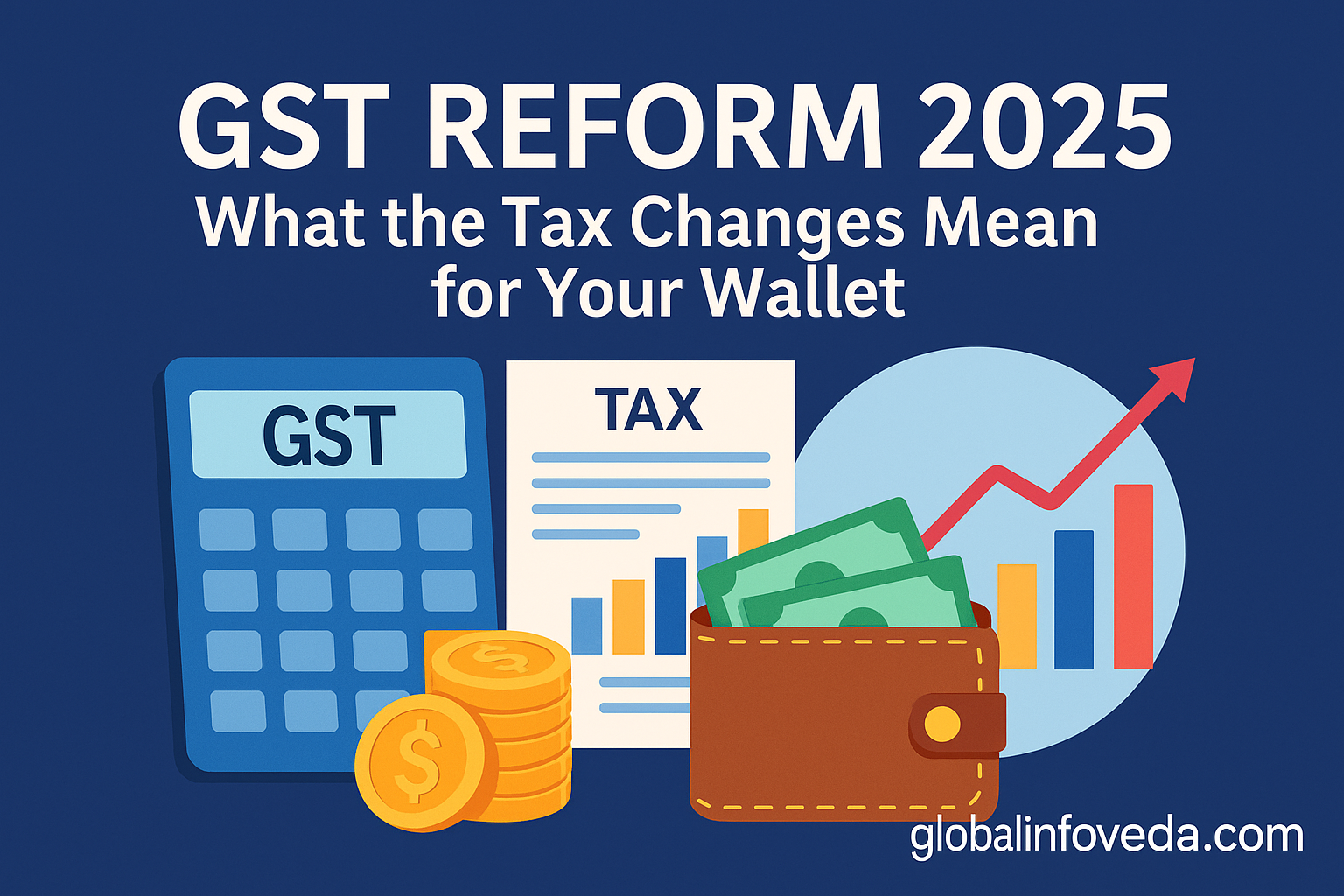
GST Reform 2025: What the Tax Changes Mean for Your Wallet
🧩 How input tax credit becomes the silent price lever
Input tax credit allows a business to offset tax paid on inputs with the tax it collects on sales. When rules are opaque, C.F.O.s charge credits against pricing, assume slower refunds and tie up cash in cautionary buffers. GST reform 2025 restricts matching, is expanding the legitimate overheads base and will auto‑reconcile e‑invoices, through sacrificing the cost of certainty. Even if the rate you pay on your product does not change, the effective “all‑in” price can slide, because fewer rupees get parked in the system. The benefit is quiet, yet mighty: It washes across millions of transactions and appears as a calmer line in your budget tracker rather than as a single orgasmic discount day.
🧰 Small business readiness checklist
- ✅ E‑invoice compliance: ensure device‑friendly tools for field teams; create a backup queue for patchy networks.
- ✅ Vendor hygiene: shortlist suppliers with consistent GSTR‑1/3B discipline so your credits don’t get blocked by their lapses.
- ✅ SKU mapping: clean HSN codes to reduce notices and rework; align POS with ERP so rates sync reliably.
- ✅ Cash flow buffers: model refund timelines by season; don’t plan festive inventory with optimistic credits.
- ✅ Customer education: print simple tax breakdowns to reduce disputes at the counter.
🛠️ The new return experience for proprietors
The clearest message to owners is fewer keystrokes and more machine brainstorming. As more of your B2B trade is now e‑invoicing (and this now includes many services), your sales and purchase registers pre‑populate and mismatch notices become less frequent. The portal asks for exceptions rather than for all data entry. Where previously a mismatch across two states might have frozen credits for months, the new risk engine uses finer thresholds, triggering only when patterns truly look anomalous. This lowers the drag of their operations that had kept many traders skeptical about scaling beyond composition thresholds. Together, these steps make growth less daunting: passing through a turnover bracket no longer unleashes an avalanche of paperwork.
🔄 Refunds: from cliff‑edge to predictable slope
- ⏱️ Time bands: exporters and seasonally spiky businesses get clearer refund ETAs; a predictable slope beats the old cliff‑edge of uncertainty.
- 📦 Documentation packs: standard templates reduce back‑and‑forth; digital attachments and e‑signs cut courier costs.
- 🧮 Risk‑based stop‑checks: fewer blanket holds for entire categories; brand‑new entities face more scrutiny than veteran filers.
- 🔍 Transparency: dashboards show stage‑wise status and reasons for any pause so finance teams can respond quickly.
🧯 Compliance burden vs peace of mind
The counter point to GST reform 2025 is that more businesses will be required to play by the digital rules —for e‑invoicing, and vendor matching in particular. That can be a burden for first‑time registrants. But the peace‑of‑mind dividend is real: once you’ve internalised the flow, audits produce structured data rather than ambush jaw‑drops; credits clear through the bank without ceaseless reminders; suppliers who take liberties stand out because their filings don’t tally with your books. For the honest operator, the system finally appears to be developed for them, not against them.
🧮 Table — Everyday retail impact
| Consumer basket | Likely tax movement | Household takeaway |
|---|---|---|
| Staples & hygiene | Mild relief or flat | Stable budgets; store brands gain share |
| Dining & small services | Clearer billing; some kitchens get credit access | More consistent menu pricing |
| Gadgets & appliances | Mixed; mid‑tier often steadier on better ITC | Stretch rupee further with mid‑range models |
🧭 Case study — a neighbourhood restaurant chain
Pre‐reform, a three‐outlet biryani brand was encumbered by credit blocks on kitchen equipment and delivery SaaS. Post‑reform, clearer restrictions on which inputs were eligible and which vendors were valid made working‑capital choke points slimmer. The team recycled menu engineering on top of fresh credits, steadied prices in the face of food inflation, served up QR‑ordering that plugged itself directly into their e‑invoice pipe. The silent win was staff morale, as managers no longer lived in dread of the unexpected misclassification notice, with both POS and ERP having a single source of truth for rates. The chain had penetrated to a fourth outlet without the need to raise menu prices, believing instead in the refund calendar more than gut feel.
🧭 Case study — a boutique manufacturer in Coimbatore
A family-owned seller of small home and kitchen appliances across five states says it used to pad prices, to give itself some cushion for refunds if caught in the middle between jurisdictions. Post-GST reform 2025, speedier cross-state validations and precise product mapping cut down credit friction. The company switched from cash‑on‑delivery to QR‑first collections, reduced settlement lags, and launched a warranty chatbot that answers in Tamil and English with full tax breakdowns on spares. Now, with logistics vendors, at last, passing through their credits smoothly, the manufacturer provides one free installation in an additional city; and its cost has dropped a few basis points.
🧭 How the new slabs shape behaviour
- 🎯 Essentials stay stable to protect low‑income consumption.
- 🧃 Sugary beverages and environmentally negative items edge up to signal public‑health and climate priorities.
- 📺 Mid‑range electronics hold steady on stronger credits; top‑end luxuries see less relief.
- 🩺 Health devices remain moderate when backed by clean paperwork and exemptions where notified.
- 🏠 Renting to businesses and certain services get rate clarity, reducing disputes between landlords and tenants.
What Is Inflation and How Does It Affect Your Daily Life?
🧭 The CIO view — finance stacks that survive audits
If you run finance systems your north star is data integrity. Map HSN/SAC very strictly, integrate ERP with POS and e‑invoice gateways and keep a single product dictionary with clear rate notes. Create reconciler bots to marry vendor filings to your purchase register every evening, and flag anomalies for humans. Save rate change memos in your master data so if a future officer asks why a tax line changed, you can produce the trail immediately. Document your refund calendar by season and region to anticipate cash swings — that planning discipline makes you a calmer negotiator with suppliers and bankers alike.
⚖️ The legal pulse you should track
- 📜 Advance ruling forums—now harmonised more tightly—lower interpretational divergence across states.
- 🧰 Anti‑profiteering frameworks evolve; demonstrate fair pass‑through of tax relief to avoid reputational risk.
- 🛡️ Audit analytics rely on anomaly flags; keep governance evidence ready for high‑variance months.
- 🧾 E‑invoicing thresholds expand; watch notifications to avoid a rushed scramble.
🧮 Table — Small business vs mid‑market operators
| Profile | What gets easier | What needs attention |
|---|---|---|
| Nano & small | Pre‑filled returns, vendor nudges | Device‑ready e‑invoicing, stable internet |
| Mid‑market | Cross‑state credits, refunds | Multi‑state SKU mapping, audit trails |
| Exporters | Risk‑weighted refunds | Documentation discipline, data rooms |
🏦 Your wallet: consumers vs proprietors
For consumers, the reform is generally experienced as more stable bills, less frequent price spikes and more-transparent lines on the bill for taxes. This should reduce the tax on benefits earned from spending on your credit card to encourage you to compare offers apples‑to‑apples. Owners get some relief from the operational grind: They use their time not in fire-fighting mode around notices, but planning, say, a new promo or inventory. The delta is larger in services where there are flows of revenue and input purchases through e‑invoices in both. And everyone benefits from the culture shift — when compliance becomes routine, rather than a monthly cliffhanger.
🧭 How digital payments and UPI fit the picture
- 📲 UPI and QR settlement proofs attach to e‑invoices, easing audits and creating cleaner trails for input credits.
- 🧩 Card‑on‑file tokenisation ties receipts to customers without exposing raw PAN data.
- 🛠️ UPI AutoPay assists subscription services in charging on the same invoice cycle, simplifying revenue recognition.
- 🛰️ Offline UPI and fallback QR flows help kirana stores comply even during patchy network windows.
UPI 3.0 Introduces Voice Payments: A Leap Toward Conversational Transactions
🛒 Pricing psychology: why some items feel cheaper even if rates don’t move
The clean ITC and refunds is also with the businesses, which don’t have to “mask” the risk in the base price. You may see more round MRPs instead, fewer end‑of‑month fire sales and subtle “everyday value” repositions, rather than one-off discounts. Subscriptions—meals, SaaS tools, over the top — are stable as vendors finally believe in their refund calendar. And consumers welcome reduced volatility: a quiet price line is better than a roller‑coaster even if the average rate is unchanged. Over time, that stability makes for improved household planning and less financial stress.
🧭 Sectors that feel the reform earliest
- 🧪 Pharma & health retail: strong push for e‑invoice compliance, cleaner spares classification, faster credit on logistics.
- 🧵 Apparel: mid‑market brands standardise labels, trim litigation risk; factory‑to‑store credits flow more predictably.
- 🍴 QSR & cloud kitchens: consolidated kitchen software, procurement mapped to HSN, fewer disputes with aggregators.
- 🧰 Home improvement: installers adopt QR billing; spares and labour mapping reduce conflict at service desks.
- 💻 SaaS: cleaner cross‑state supply place rules; better ITC on cloud improves B2B pricing.
🧮 Table — Where households might re‑allocate spend
| Category | Likely direction | Budget move |
|---|---|---|
| Essentials | Stable | Free up room for savings |
| Experiences | Steady to mild rise | Swap toward weekday dining, local travel |
| Gadgets | Hold or fall in mid‑tier | Delay top‑end upgrades; buy value tiers |
🧭 Personal finance moves for 2025
If you keep track of your expenses, create a “tax clarity” tag in your budgeting app to mark categories where billing became less complicated. Use it to renegotiate subscriptions or demand service plans where merchants get input credits. Reprice big‑ticket buys after festivals — mid‑tier gadgets and appliances may give you better lifetime value as ITC pass them on. For households with freelancers, sync invoices to the client’s return cycles to speed up receivables. For small landlords who give rent to registered businesses, clarify rates and also mention their GSTIN in their agreements — this can avoid mismatched filings in future.
🧠 The economics underneath: why simplification crowds‑in growth
Simpler taxes reduce deadweight loss. When classification mayhem and refund uncertainty ease, companies spend more time making products and less time arguing notices. The result is higher productivity, and a small but real lift to G.D.P. Longer-term, broader base + steadier compliance also gives the state the leverage to cut rates on essentials without blowing a hole in the budget. The credibility effect counts — investors, lenders and overseas buyers would rather operate in jurisdictions where tax math is less an unknown. GST reform 2025 is, after all, a growth mechanism presented in the guise of paperwork rationalisation.
The Rise of Open Finance: From Banking to Full Financial Ecosystems
🧭 CFO toolkit for the new regime
- 🧭 One product truth: a master HSN/SAC dictionary with attached circulars.
- 🧮 Nightly reconciler: vendor GSTR vs your purchase register; block future orders from chronic defaulters.
- 🗂️ Refund planner: cash calendar by state; model seasonality and working‑capital peaks.
- 🔐 Audit vault: store signed PDFs of e‑invoices and rate memos; tag by SKU and region.
- 📊 Exception board: track notices, escalations, and resolution time as KPIs.
🧭 India’s federal compact: centre‑state coordination in practice
So the GST reform 2025 imperceptibly tightened how states and government share data and enforce laws. In practical terms, that means a return that’s filed in one state cross‑checks smoothly with credits claimed in another for the same tax year to ensure tax has been paid. It also translates into fewer surprises when trucks fly across borders, as e‑way bills and e‑invoices reside in the same realm. For retailers with stores in multiple states, the warehouse location decision has become a cost‑to‑serve decision not a tax engineering exercise. For consumers, the unseen plumbing means fewer stock‑outs around festivals because logistics time cushions diminish.
🧭 Consumer rights supercharged by transparency
- 🧾 Itemised bills with clear GST lines help spot overcharging at restaurants and salons.
- 🧑⚖️ Grievance escalation is easier when invoices carry IRN/QR—a screenshot is evidence.
- 🧭 Price comparison improves online; marketplaces standardise tax fields so you don’t compare apples and oranges.
- 🛡️ Refunds from cancelled services get processed faster as gateways reconcile tax reversals.
🧭 Labour and jobs angle
Compliance tech is a jobs engine: small and medium-sized enterprises hire implementers in connection with e‑invoice tools, a reconciler and training. The clean audit trail, meanwhile, creates a bias in favour of those businesses that pay fairly and pay on time, driving the fly‑by‑night operators from the market. QR‑first billing shifts the tempo of the day for field sales and delivery teams but minimises the friction at gates. The modernized tax back‑office is, after a year or two, just another digital muscle — less drama, more routine.
🧭 City‑by‑city nuance you’ll notice
- 🏙️ Mumbai: service sectors see the earliest stabilisation; restaurant bills read cleaner.
- 🏙️ Bengaluru: SaaS and D2C adopt reconciler bots; refunds speed up for exporters.
- 🏙️ Delhi‑NCR: multi‑state retail chains consolidate warehouses; e‑way checks feel smoother.
- 🏙️ Chennai/Coimbatore: manufacturing pairs QR billing with spares classification discipline.
- 🏙️ Jaipur/Surat: textiles and gems standardise HSN; fewer rate fights at assessment.
🧭 Pitfalls to avoid in the transition
- 🚫 Treating the new slabs as optional—update POS/ERP on day one to avoid misbilling.
- 🚫 Ignoring vendor compliance risk—your credits can still be blocked by their defaults.
- 🚫 Under‑investing in device readiness—handhelds and printers matter in field‑heavy sectors.
- 🚫 Over‑promising price cuts—wait for credits to flow before making public claims.
GST Overhaul: How Modi’s $20B Bet on Consumption Drives Tax Reform
🧭 How the reform intersects with inflation
Inflation pass-through can be mitigated via stable credits and predictable refunds by reducing pricing uncertainty premium. Where rates are increased for good health or climate reasons, the reform is a signal of intention, not a shock from which businesses have no time to adapt and improve messaging. Households that look ahead—prepaying school fees, batching electronics purchases around seasonal windows and locking in subscriptions—can neutralise a lot of the short‑term noise while gaining the long‑run advantage of a more predictable price line.
🧭 Exporters: special notes
- 🚢 Maintain product‑wise rulebooks for destination markets; some trading partners care about invoice data formats.
- 🧾 Adopt e‑signature workflows that align with customs filings; avoid re‑work.
- 💱 Hedge working‑capital risks by matching refund timelines to bank credit lines.
- 📦 Keep a clean trail for freight and insurance so authorities don’t question zero‑rating claims.
🧭 The home entrepreneur’s guide
If you operate a home baking business, coaching class or design studio, the reform means better templates and more predictable refund maths when you make purchases that you use to make money—subscribing to a cloud service or buying an oven, for example. Your pricing should be transparent in terms of a tax line to reflect the taxation and a QR payment option + that alone will build trust and reduce negotiation time. And for repeat customers, set a calendar reminder to e‑invoice them on the same day every month and keep the item description short. Consistency is a brand moat in services; tax clarity bolsters it.
🧭 Advanced play: using analytics to keep prices sharp
- 📊 Build a price‑watch board that tracks input costs, effective tax, and refunds cleared.
- 🧲 Use category heatmaps to spot where credits aren’t flowing; renegotiate with those suppliers.
- 🧮 Benchmark outlet‑wise effective tax rate; standardise best practices across regions.
- 🧩 Correlate refund speed with promo timing; don’t run discounts when cash is tight.
🧭 Frequently asked questions
- Will every bill get cheaper now? Not always. Essentials stabilise; some categories move up by design. The bigger gain is stability and clarity.
- Do I still need to save paper invoices? Digital is fine if the IRN/QR is visible and you back up regularly.
- What if a vendor refuses to show GSTIN? Push back; without it your credits may fail or consumer recourse weakens.
- Can I recover old blocked credits? Transitional windows are specific; talk to your accountant with invoice details.
- Is cash still okay at kirana? Yes, but QR/UPI‑tagged bills help everyone in audits and refunds.
🧭 Myth vs reality
- 🔍 Myth: “New slabs will crash prices everywhere.”
Reality: Some items ease, others rise; the durable benefit is smoother credits and fewer disputes. - 🔍 Myth: “Small shops will drown in rules.”
Reality: Pre‑filled returns and simple tools reduce friction after the first month of setup. - 🔍 Myth: “Audits will get harsher.”
Reality: Analytics target real anomalies; compliant traders face fewer surprises.
🧭 What to watch over the next 12 months
- 🗓️ Notifications that tweak HSN notes and close loopholes.
- 🧪 Pilot projects that pre‑fill return annexures for more categories.
- 🏦 Banks offering invoice‑discounting products mapped to refund stages.
- 🛒 Retailers moving to cleaner price‑promise language tied to ITC clarity.
FY26 Outlook: A “Steady as She Goes” Economy—But Watch Tariffs & Credit Flows
📚 Sources
- GST Council / CBIC (Central Board of Indirect Taxes & Customs) — official updates, circulars, and FAQs: https://www.cbic‑gst.gov.in and https://www.gstcouncil.gov.in
- Ministry of Finance (Department of Revenue) — press notes and notifications: https://dor.gov.in and https://www.finmin.nic.in
- Reserve Bank of India — monetary policy and inflation analysis: https://www.rbi.org.in
- Press Information Bureau — authenticated government releases: https://pib.gov.in
🧠 Final insights
GST reform 2025 is not a miraculous panacea that halves every bill. It is a credibility-making machine, that makes prices calmer and credits cleaner and refunds predictable. The visible effects come in the form of more stable MRPs, QR‑first billing, and less confusion over which rate to apply to a particular service. The invisible impacts are greater: Reduced working‑capital stress for SMEs, better risk engines for audits, and a level playing field that punishes opaque operators. For households, the smartest thing to do is to keep those few categories on the radar and switch spend to where the view is looking up because of reduced input tax credit and a more seemless supply chain. For businesses, the winner is teams that map HSN cleanly reconcile daily, and peg pricing to refund reality, not hope.
👉 Explore more insights at GlobalInfoVeda.com