







🎯 Introduction
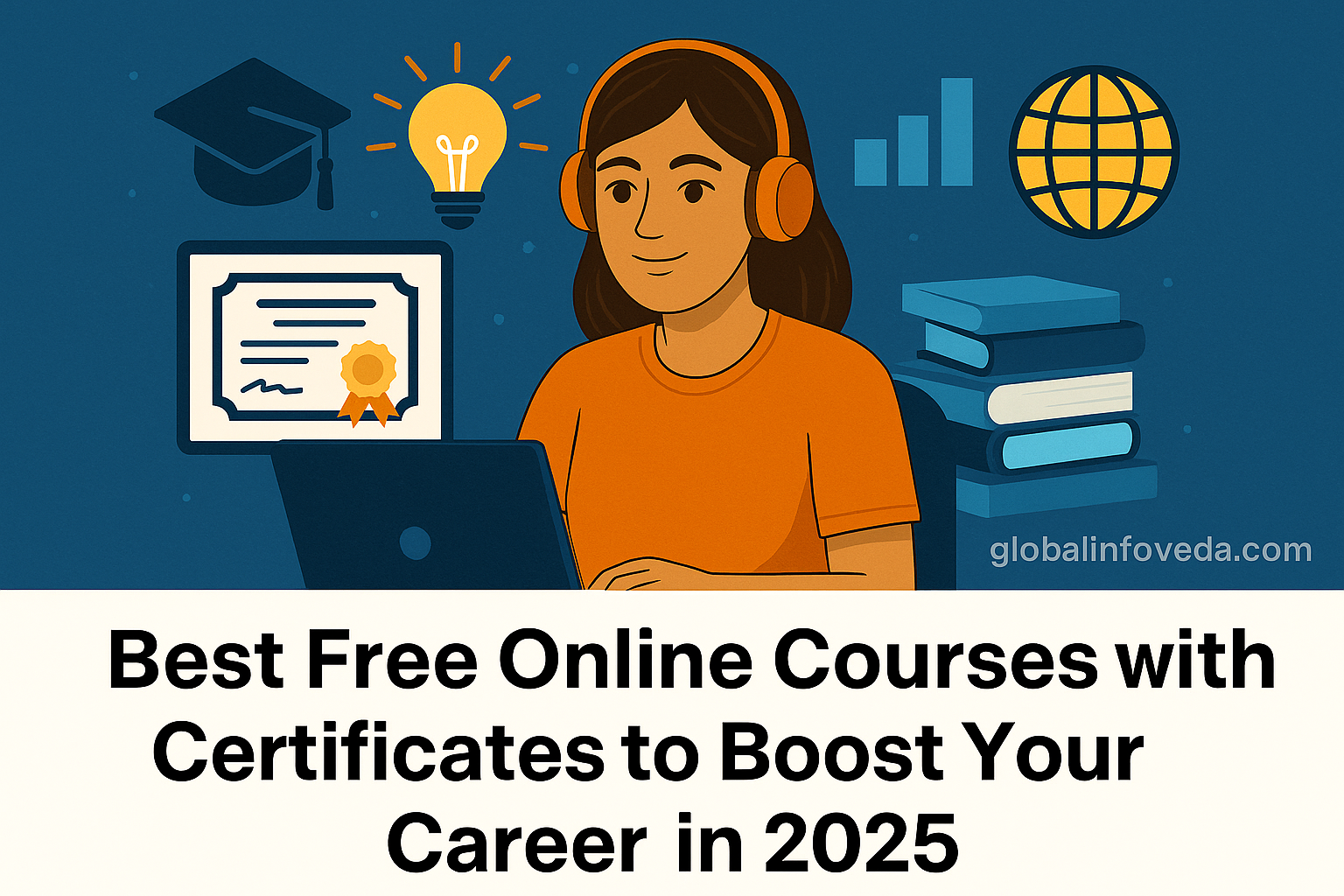
Free online courses with certificates are no longer a luxury item; they’re a quick, low-risk way to futureproof your career in 2025. From MOOCs and vendor academy programs to employer‑recognized digital credentials, you can develop job‑ready skills without taking on student debt or leaving your job. In this comprehensive guide, we explain exactly how to choose the right platforms, which skills to focus on during your free time, how to verify that a certificate is indeed free (or low‑cost), and the most effective way to use your free time learning online to get real results — in the form of interviews, freelance gigs, job changes, and raises.
Meta description: From these best free online courses with certificates in 2025, you can craft your career. Compare platforms, choose winning skills, and follow step‑by‑step guidance to learn job‑ready know‑how.
🧭 How to choose the right course
- 🔎 Define the job outcome first: shortlist 2–3 roles (e.g., data analyst, digital marketer, project manager), then map each to a skill stack.
- 🧪 Check certificate terms: some platforms give a free certificate or badge; others require a small fee; a few enable financial aid.
- 🏷️ Look for brand recognition: vendor academies (Google, Microsoft, IBM, AWS) and top universities carry hiring weight.
- 📚 Verify curriculum depth: does it include projects, assessments, and feedback? Avoid pure slide‑shows.
- 🔁 Plan for application: choose courses that feed into a portfolio, GitHub repo, or live case study you can share.
- ⏱️ Time budget: aim for 2–5 hours/week per course; stack short micro‑courses before long specializations.
🧩 Skills that move the needle in 2025
- 📊 Data analytics: spreadsheets, SQL, Python, visualization.
- 🛡️ Cybersecurity: threat modeling, network fundamentals, cloud security.
- 🎯 Digital marketing: SEO, content strategy, analytics, paid ads.
- 🧠 AI literacy: prompt design, RAG basics, model limits.
- 🛠️ Low‑code automation: no‑code tools, APIs, workflow builders.
- 📦 Product management: user research, MVPs, roadmaps, metrics.
Top 10 SEO Hacks to Rank Your Blog on Google Fast
🧱 Platform snapshot
| Platform | Certificate status | Best for |
|---|---|---|
| Google Digital Garage | Free certificate (select courses) | Digital marketing starters |
| HubSpot Academy | Free certifications | SEO, content, CRM |
| IBM SkillsBuild | Free badges | Data, AI, cybersecurity |
| Microsoft Learn | Free badges; vouchers occasionally | Azure, Power Platform, AI |
| Kaggle Learn | Free certificates | Python, ML, SQL |
| OpenLearn (OU) | Free badges | Soft skills, project mgmt |
| AWS Educate/Skill Builder | Free badges | Cloud basics, serverless |
| Meta Blueprint | Free course certificates | Facebook/Instagram ads |
| Coursera/edX audits | Audit free, cert paid/aid | University content |
Note: Always check the current certificate policy on the course page; platforms change terms.
🚀 Learning paths that lead to interviews
- 📊 Data analyst (8–12 weeks): Kaggle Python + SQL micro‑courses → Google Sheets/Excel for analysis → 1 capstone dashboard in Looker Studio/Power BI with a short case write‑up.
- 🎯 Digital marketer (6–10 weeks): Google Digital Garage fundamentals → HubSpot SEO + content → set up a blog/landing page, run a tiny ad test, and publish results.
- 🧠 AI‑enabled generalist (6–8 weeks): prompt engineering basics → automation with Zapier/Make → build a small workflow (summarize, tag, email) and document it.
- 🛡️ Cybersecurity starter (8–12 weeks): IBM SkillsBuild network basics → Microsoft Learn security fundamentals → home lab with threat modeling exercise and a resume STAR story.
Visual & Video SEO: The Top Formats Winning Search in 2025
🔍 Certificate value vs outcomes
- ✅ Recognized issuer: vendor academies (Google, Microsoft, IBM, AWS) or well‑known universities signal quality to hiring managers.
- ✅ Portfolio artifact: convert each course into a visible dashboard, repo, campaign, or case study with results.
- ✅ Outcome story: craft a concise STAR narrative (Situation‑Task‑Action‑Result) that proves you can apply the skill.
- ✅ Skill mapping: mirror job‑post keywords (SQL, GA4, SEO, Python, Excel) in your project titles and descriptions.
- ✅ Verification: add the digital credential link to LinkedIn and resume so recruiters can confirm authenticity.
🧪 Case study: switching into analytics in 90 days
A 2 years’ experienced content writer wants to transition to data analytics. She finishes some Kaggle Python and SQL micro‑courses and then creates two Google Sheets dashboards for her current team, which saves time for weekly reporting by automating with a Looker Studio view. She includes one of the A/B test write‑ups — comparing two content formats — as well as a brief post on the pipeline and results. Result: interviews for junior analyst positions — not for an MBA, but for free online courses + a portfolio.
AI Overviews Rule SERPs—How to Get Featured When Clicks Disappear
🧰 Course picking checklist
- 🏷️ Issuer: vendor/university > unknown brands
- 🧪 Assessment: graded quizzes, projects, peer review
- 🧰 Tools: industry‑standard (e.g., SQL, Python, Excel, GA4)
- 📦 Portfolio: explicit artifacts to showcase
- 🗂️ Syllabus fit: aligns to job descriptions you’ve saved
- 🔁 Pathway: connects to advanced courses or a capstone
🧮 Platform/skill map
| Skill | Starter platform | Portfolio artifact |
| SEO & content | Google Digital Garage, HubSpot | Site audit, content plan, mini campaign |
| Analytics | Kaggle, Microsoft Learn | Dashboard, SQL queries, case write‑up |
| AI literacy | IBM SkillsBuild, Microsoft Learn | Prompt library, small automation |
| Cybersecurity | IBM SkillsBuild | Threat model, hardening checklist |
| Cloud | AWS Educate, Azure Fundamentals | Deployed static site/serverless function |
First‑Hand Expertise—Why Personal Experience Is SEO Gold in 2025
🧑🏫 Standout platforms and courses
🟦 Google Digital Garage
- 🧭 Fundamentals of Digital Marketing (with free certificate). Covers SEO, SEM, analytics basics; solid first credential for non‑tech roles.
- 🧩 Pair with a mini campaign (₹500 test) and a report; employers care about outcomes.
🟧 HubSpot Academy
- 🎯 SEO, Content Marketing, Email Marketing (all with free certifications). Highly visible in marketing hiring.
- 🔁 Refresh certs yearly; add campaign screenshots and KPIs to your portfolio.
🟪 IBM SkillsBuild
- 🧠 Data fundamentals, AI, cybersecurity. Issuer is respected; badges are free.
- 🧪 Use lab tasks as portfolio proofs; write a short post on what you built.
🟩 Microsoft Learn
- ☁️ Azure fundamentals, Power Platform, AI learning paths with free badges.
- 🎟️ Watch for limited exam vouchers via challenges; even without vouchers, badges + labs help.
🟫 Kaggle Learn
- 🐍 Python, Pandas, SQL, ML micro‑courses with free certificates.
- 📈 Convert exercises into a small analysis project and publish on GitHub.
🟨 OpenLearn (Open University)
- 🧩 Project management, soft skills, writing with free badges.
- 🧱 Good add‑ons to technical stacks; show communication capacity.
🧑💼 Use your certificate to get hired
- 🧾 Add issuer + link to LinkedIn, resume, and email signature.
- 🗺️ Translate course topics into skills on your profile (e.g., SQL, GA4, A/B testing).
- 🧰 Build a 1‑page portfolio: 3 artifacts with 3‑line summaries; link to repos and live dashboards.
- 🗣️ Develop STAR stories from projects (Situation‑Task‑Action‑Result) for interviews.
- 📨 Send 10 show‑and‑tell messages to hiring managers; ask for 15‑minute feedback chats.
Zero‑Click Searches & AI Snippets: How to Still Drive Blog Traffic in 2025
🧩 Common pitfalls
- 🌀 Chasing too many certificates without depth or a portfolio.
- 🧱 Taking only theory; skipping hands‑on labs.
- 🏷️ Picking unknown issuers with low signal to employers.
- ⏱️ Underestimating time; dropping courses in week 2.
- 🧲 Forgetting application; no projects, no interviews.
🧪 Case study: marketing coordinator to growth role
A marketing coordinator stacked Google Digital Garage and HubSpot SEO certs, then taxied a ₹1000 A/B test experiment to the runway with two landing pages. She wrote down the hypothesis, test design and kpis. Two months later she had one case study, one dashboard, and three short posts. Recruiters replied to her because her free online courses were linked to visible action.
🧰 30–60–90 day plan
- Days 1–7: choose a role, enroll in one free certificate course, set a study slot.
- Days 8–30: finish core modules; start a small portfolio project.
- Days 31–60: complete project; publish a short write‑up and share it.
- Days 61–90: add a second course that deepens the same skill; refine portfolio; book informational interviews.
📚 Glossary
- MOOC: massive open online course; usually self‑paced, open enrollment.
- Digital badge: verifiable credential proving completion/skills.
- Portfolio: public evidence of ability (code, dashboards, campaigns).
- Financial aid: need‑based fee waivers for paid certificates.
🔎 References
- UNESCO – Guidance on digital skills and lifelong learning (Global Education Monitoring). https://www.unesco.org
- U.S. Bureau of Labor Statistics (BLS) – Occupational Outlook Handbook for job growth and skills. https://www.bls.gov
- European Commission – Digital Skills & Jobs platform resources. https://digital-skills-jobs.europa.eu
🧾 Financial aid and vouchers
And financial aid can make paid certificates more free or low‑cost victories. Look for on‑platform help forms, limited voucher challenges and university audit modes where the course is free but the certificate costs money — sometimes waived with need‑based aid. Time‑bound promotions crop up around skill challenges or area upskilling initiatives; complete every module and the platform might email an exam voucher. When aid is not applicable, focus on free online courses that offer portfolio artifacts and worry about the certificate later (when the recruiter requests it).
🧩 ATS keywords and LinkedIn optimization
Both ATS and LinkedIn search are keyword driven. Collect 10–15 skills from real job posts (e.g., SQL, Python, Power BI, GA4, SEO, A/B testing) before you sign up. Once you finish a few free online courses, title your projects with those terms and tag your certificate descriptions accordingly. Maintain a one‑page portfolio, with three pieces of artifauct: a dashboard, a campaign, and a mini‑automation. Each is given a 3‑line summary and links. Update LinkedIn: add a pin to your portfolio, add the new credential, write a 2‑line headline with target skills.
🗓️ Weekly schedules that work
If you have a full‑time job, think of learning as a standing meeting. Running two 60‑minute weekend and one 90‑minute weekend build session is enough to complete 1 short course per month. Schedule weekday slots for lectures and quizzes, weekends for projects, reflection. The ratio of theory-to-practice can be reversed entirely—short theory bursts every day, but a weekly project sprint. The idea is consistency: Set time blocks, a minimalist habit tracker, and a visual streak. “I’d protect the schedule by picking individual micro‑courses first, and then chaining them into something bigger once you believe in the routine.”
🛡️ Spot fake certificates and low‑signal courses
Not all certificates carry weight. Red flags include no issuer identity, pay‑to‑print PDFs without a verification link, no syllabus or projects replaced by a slideshow quiz. Courses with badges that can be verified, issuer pages, and public curriculum are to be preferred. See if there are alumni projects; if no one is sharing artifacts, program may be fluffy. Write one piece, do a bit of the test for it and see how recruiters perform before continuing to go down that path.
🧮 Return on learning timeline
Don’t be surprised if there is a lag time between the end of completing a course and getting interviews. during month 1, Ship first Artifact and collect 1 certificate. In the categories of more poncey, 2 months refine artifact, post short write‑up. In month 3, add a second Artifact that deepens the same skill, and then begin outreach — 10 high-value messages with a show‑and‑tell link. The biggest traction comes from not artifact two but certificate one. Keep iterating: small projects grow faster than piling up certificates with no visible return.
🌏 Local relevance
Free offerings change by region. In India, watch for university‑backed portals (eg., SWAYAM, NPTEL) as well as vendor academies; in Europe, see the resources of Digital Skills & Jobs; in North America, community college bridges and public library labs often tag along MOOCs with exam support. Where ever you are make the issuer, assessment, and cost of the certificate is verified that it is a free one will be available to check if the certificate is free or only if you pass a paid exam. Local meetups and hackathons can turn online learning into references — more powerful than an extra badge.
🧭 Personal analysis
The shortest road to a portfolio that solves a real problem, not the longest specialization. Max the following 1 role 2 skills and 3 artifacts. Anchor each segment to something you can ship in the next four weeks. Turn your current job into a lab: automate a report, try a little A/B testing, or construct a one‑page dashboard for a frequently‑asked question. The correct free online courses are accelerants, but the spark is your applied practice. As you gather replies to your artifacts, double down on that skill cluster.
🧠 Final insights
Free online courses are leverage only when they produce evidence: a real certificate, a real portfolio piece, and a repeatable story about your impact; so, choose a short job‑linked learning path, convert every module into something you can show, keep a steady weekly cadence of work, and ship outcomes at 30‑day intervals—if you do that, your 2025 career will compound faster than any single credential could promise.
👉 Explore more insights at GlobalInfoVeda.com