







🌱 Introduction
In 2025, a new expression for digital conscience is being thrust upon pop culture, boardrooms and classrooms — AI veganism. Just as food veganisms prevent animal suffering by scrutinizing sources, labels and supply chains, AI veganisms invite us to investigate how data is extracted, how models are trained, whose labor invisibly cleans our data sets, and what forms of cognitive harm our tools can inflict at scale. The concept is clear but its implications are far-reaching: develop and deploy ethical AI with reduced extraction, exploitation, and externalities, that means less invasive surveillance and bias, less wasteful compute and doom-scroll design. This is not anti‑technology, it is pro‑human, pro‑planet, pro‑agency. For creators, founders, educators and regulators, the movement provides a concrete playbook for aligning innovation in service of our values and for designing systems that treat trust as a feature, not an afterthought.
Meta description: What is AI veganism in 2025? A practical framework to use and build ethical AI that reduces data harm, bias, and surveillance while protecting dignity.
🧭 Defining AI veganism in plain terms
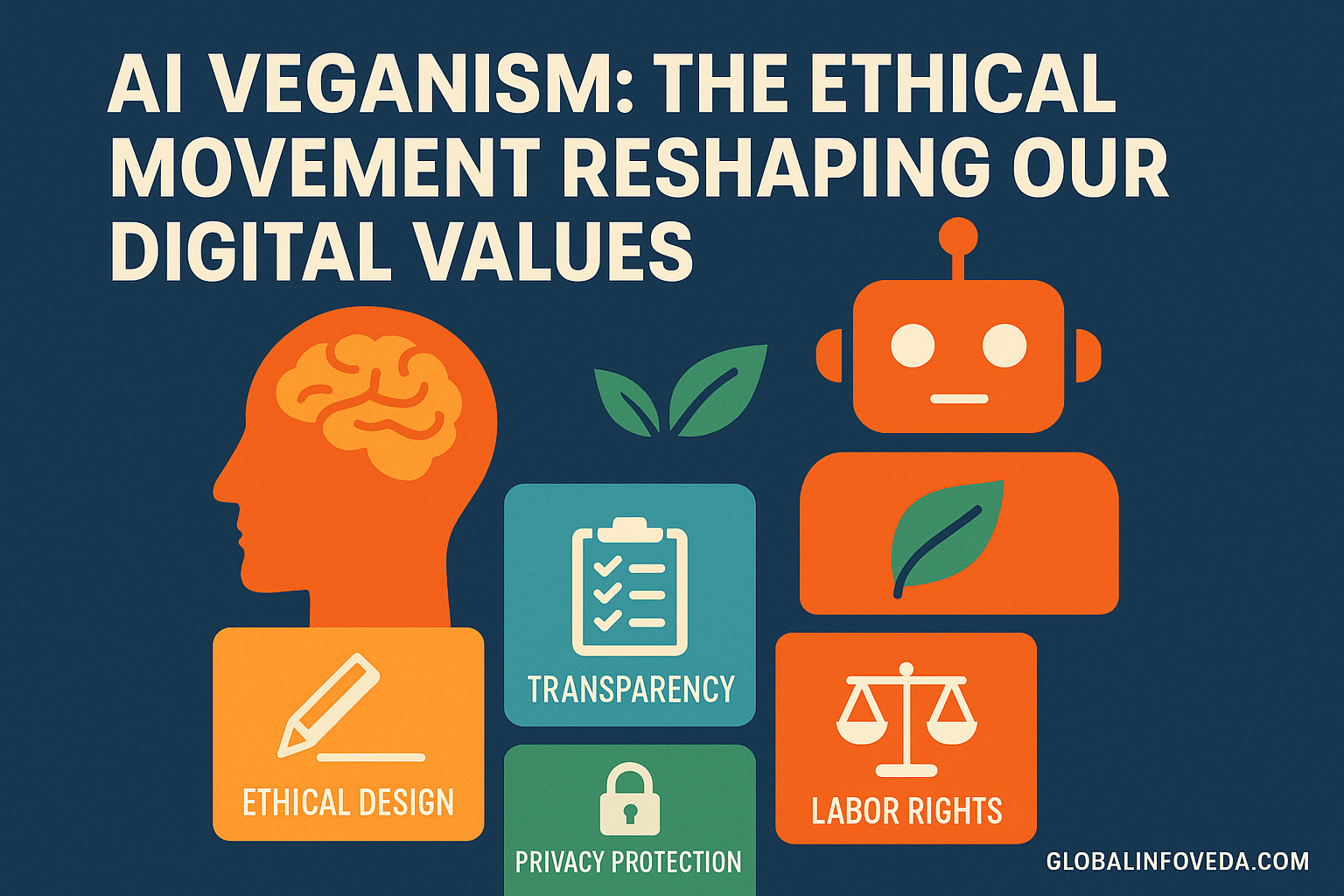
AI veganism is a value‑driven practice of creating and using artificial intelligence technology without “digital animal products”: information taken without consent, black‑box systems that cannot be inspected, deceptive interfaces, and a culture of compute that shrugs off energy and e‑waste. It derives clarity from food labeling: If you wouldn’t eat something of unknown ingredients, why should you use a model trained on mystery data, or shipped with dark patterns? The fundamental principles are transparency (know the input), consent (respect rights), fairness (audit outcome), sustainability (optimize energy), and responsibility (provide appeal and redress). For users, that means selecting privacy‑respecting tools, and rejecting systems that profiling or biometric tracking don’t justify. For builders, that means proving provenance, testing for algorithmic bias and providing humans with real — not cosmetic — override options.
🔎 Origin story and the ethics lineage
The term AI veganism was bubbling up from design communities that had already been exploring slow tech, calm computing and repair culture. It draws in intellectual debt from human rights by design, the free/libre open‑source movement, feminist data ethics, and environmental justice. Rather than kicking ethics down the can as a pair of rose-tinted glasses to be adopted in a far, far future which is only ever round the corner or at least beyond the next pivot, AI veganism places the responsibility upstream: at the moment you choose a dataset, sketch a UI, determine default permissions. “That upstream perspective re-frames engineering choices as ethical choices with real societal consequences. It also redefines business models: attention arbitrage gives way to trust arbitrage, where the company that wins trust retains customers longer and surf the regulatory waves more smoothly.
📦 The five‑ingredient label for ethical AI
- 🧬 Data provenance: Is training data consented, licensed, or public‑domain? Can we surface sources when asked?
- 🧑⚖️ Human rights impact: What are the foreseeable risks to privacy, expression, non‑discrimination, and due process?
- 🔍 Auditability: Are there logs, datasheets, and model cards? Can external auditors reproduce tests?
- ♻️ Sustainability: What is the energy footprint? Are we using right‑sized models and green cloud options?
- 🛟 Recourse: Do users have ways to contest outcomes, correct data, or opt out entirely without losing access to essentials?
🧠 Why this moment needs AI veganism
These past two years mainstreamed generative AI across search, productivity and entertainment. With it came a flood of scraped data, fake spam, and hallucinated authority. Creators watched as their work got consumed without consent; workers faced algorithmic management; students struggled with the overuse of A.I. Meanwhile, demand for big models of electricity surged and content platforms leaned toward “views at any cost”. At this juncture, AI veganism comes across as a positive refusal — a way to hold on to what’s miraculous about AI but reject the exploitive pipelines. Call it ethical minimalism: fewer, stronger features; clearer limits; meaningful consent; and legible defaults. More importantly, it’s not just a personal position; it’s a market signal that incentivizes companies to treat trust as a moat.
🧩 Pillars of practice (builder edition)
- 🧾 Consent‑first data: Contracted, licensed, or user‑donated datasets with granular controls and retention limits.
- 🧪 Bias testing at the edge: Run fairness evaluations per cohort; publish gaps, fixes, and re‑test dates.
- 🔐 Privacy engineering: Differential privacy, federated learning, and on‑device inference for sensitive contexts.
- 🧭 Explainability by design: Model cards, decision trees around high‑stakes calls, and per‑prediction rationales where feasible.
- 🔁 Feedback to training: Structured appeal workflows where validated user feedback updates labels or weights.
- 🌿 Right‑sizing compute: Smaller distilled models, sparse activation, and low‑carbon scheduling rather than one giant model for all problems.
🎒 Pillars of practice (user edition)
- 🔎 Read the label: Look for privacy policies, data retention, and model disclosure. If none exist, treat it as ultra‑processed tech.
- 🛑 Refuse dark patterns: Reject forced consent and default microphone/camera access; revoke abusive permissions.
- 🧭 Prefer local: On‑device or edge processing for diaries, health, and children’s apps.
- 🐾 Trace your trail: Regularly export, delete, or correct your records; use alias emails and tokenized payments where possible.
- 🧰 Choose reversible tools: Pick apps that let you leave with your data in standard formats.
⚖️ What global principles say—and how they map to AI veganism
Norms of the movement are prefigured by international frameworks. The OECD AI Principles prioritize human‑centered values, transparency, robustness, and accountability. Recommendation (1)* of the UNESCO Recommendation on the Ethics of AI is that the promotion and upholding of human rights, including the rights of the child1 and of persons with disabilities, at all stages of the life cycle of AI systems are essential to the application of AI in a manner that is both beneficial for humanity and respects the environment. The EU AI Act gives practical effect to risk based obligations, ranging from prohibitions applying to all AI systems to very demanding obligations in relation to high risk systems. In India, policy discourse—via NITI Aayog’s “Responsible AI for All” and MeitY’s ongoing efforts—advocates for responsible innovation. AI veganism converts those high‑level commitments into daily checklists at the time of purchase, classroom use, product roadmaps and creator contracts.
References: UNESCO Ethics of AI; OECD AI Principles; European Commission AI Act; NITI Aayog’s Responsible AI for All.
🧮 The cost of clean data vs the price of dirty data
One could imagine that ethical AI is just slower or, when it’s not slower, pricier. In practice systems trained on consented, licensed or synthetic with disclosure data will tend to have fewer legal risk, brand crises, and better long‑term performance. Dirty pipelines—they are swirled clean with the force of legal retribution, of download takedowns and trust deficits. CFOs that modeled expected litigation, churn and compliance find ‘cheap’ data a liability, delayed.” AI veganism substitutes that bet with auditable inputs and lifecycle governance that investors can diligence.
🔬 Case study — a consent‑first language dataset
A regional ed‑tech startup was looking for a multilingual speech‑to‑text model for their classrooms. Instead of scraping platforms, it held community voice drives with opt-in consent, paid contributors and released some under a Creative Commons license. The data collected the richness of dialects and made the material more accessible for the pupils. In a span of eighteen months, the company spent much more upfront on data operations but saved on removals, PR crises, and re‑training cycles. Parents believed in the brand, schools signed contracts again, and the startup used model cards to show progress to regulators.
🧪 Case study — an explainable claims engine in health insurance
A health insurance company implemented an explainable AI- based claim triage model. Denials came with counterfactual explanations (such as “claim would be approved if X was the case”) and an appeal button that sent cases to humans. False negatives dropped, approval time decreased, and the rate at which complaints were made shrank. By revealing decision logic, the insurer soft-pedaled automation bias in its people, and responded to cuts more fairly across demographic slices. The system’s transparency became a market distinction instead of a regulatory hurdle.
🚸 Case study — a school’s AI honor code
One large urban school board began to report increased AI plagiarism and student anxiety. Instead of a blanket prohibition, it took out an A.I. honor code: announce your use of tools and cite your prompts, submit notes reflecting on how you’re learning. The board offered on‑device writing assistance that never uploaded drafts to the cloud. Teachers were provided with rubrics to assess the process, not just the product. The result: Students generated A.I.-aided brainstorms and outlines, but wrote in their own voice; disciplinary cases decreased, and digital trust increased.
🧱 Risks AI veganism refuses on day one
- 🕳️ Data voids dressed up as ground truth (unverified web scrapes).
- 🧿 Emotion recognition in hiring, policing, and education.
- 🕵️ Covert surveillance through always‑on microphones/cameras.
- 🎭 Deceptive chatbots that impersonate humans without disclosure.
- 🗑️ High e‑waste from churned devices and oversized models for trivial tasks.
🧰 A procurement checklist for institutions
- 🧾 Provenance: Demand datasets, licenses, and labeler policies.
- 🧪 Fairness: Require cohort‑level tests and re‑test schedules.
- 🔐 Privacy: Check default encryption, retention, and opt‑out mechanics.
- 🧭 Explainability: Insist on model cards, feature importances, and decision logs.
- ♻️ Sustainability: Ask for energy profiles and location of compute.
- 🛟 Recourse: Ensure user appeals and independent ombuds processes.
🧮 Table — clean vs dirty AI pipelines
| 🧰 Aspect | 🌿 Clean pipeline (AI vegan) | 🧨 Dirty pipeline (status‑quo) |
|---|---|---|
| Data | Consented, licensed, traceable | Scraped, ambiguous, takedown‑prone |
| Governance | Model cards, audits, DPIA | Black box, ad‑hoc fixes |
| Risk | Lower legal/compliance shocks | High litigations, PR crises |
🔎 Labeling the interface: how products can show their ethics
Interfaces can signal integrity the way food labels do: badges for on‑device processing, clear consent toggles, “why this suggestion?” tooltips, and obvious exits for data sharing. AI veganism argues that great design is honest design. This also combats dark patterns: infinite scroll, hidden opt‑outs, and manipulative nagging. Products that show their ingredients earn repeat usage, not just trial spikes. In short, transparency becomes a UX superpower, not a compliance footnote.
🧮 Table — where compute ethics meets carbon
| ⚙️ Compute choice | 🔋 Energy & carbon | 🎯 When to choose |
|---|---|---|
| Distilled models | Lower energy; faster inference | Mobile, edge, education |
| Sparse activation LLMs | Medium energy; scalable | Customer support, content ops |
| Monolithic frontier models | Highest energy; costly | High‑stakes research only |
🧠 How to talk about AI veganism with executives
Leaders get behind it when ethics ties to risk and revenue. Walk them through the pipeline economics: clean inputs cut takedowns and churn; explainable flows reduce support; privacy by design penetrates school and healthcare; energy wins quirks lower cloud costs and climate scrutiny. Refer to regulatory vectors (EU AI Act, sectoral rules) and to the brand value in the face of authenticity fatigue. Frame pilots with time‑boxed sprints, track churn and NPS, and publicize internal case notes. The aim is to follow an agenda which is the best one anyway, not forced by policy.
🧑💻 Creator economy: credit, consent, and compensation
- 🎨 Metadata persistence: Watermark and content credentials so works retain provenance across platforms.
- 🤝 Collective licensing: Unions or cooperatives that license catalogs to model providers on fair terms.
- 💸 Revenue share: Model usage royalties that flow back to living artists, writers, and musicians.
- 🧾 Attribution UX: Search and chat surfaces that link back to original creators, not just aggregates.
- 🧯 Anti‑spam guardrails: Rate limits and cost friction for bulk synthetic content flooding.
🧪 Classroom and campus adoption that protects curiosity
- 🧸 Child‑first defaults: No ads, no trackers, and local inference for journals and reading coaches.
- 🧪 Explain as you go: Tools that show new vocabulary sources and reasoning steps.
- 🧭 Assessment redesign: Oral vivas, process logs, and rotating prompts to reduce over‑reliance.
- 🧰 Teacher copilot: Lesson plan generators with citations and per‑source toggles to avoid hallucinations.
- 🧱 Boundaries: Bans on emotion recognition, behavior scoring, and covert proctoring.
🧮 Table — practical measures for different sectors
| 🏥 Sector | 🛠️ Immediate actions | 🔭 12‑month horizon |
|---|---|---|
| Healthcare | Local PII processing, audit trails | Federated learning pilots |
| Finance | Bias tests, appeal channels | Explainable credit models |
| Education | On‑device writing assistants | Open datasets with consent drives |
🔧 Product patterns that make ethics visible
High‑leverage design moves alter behavior without scolding. Privacy nutrition panels convert policies into one‑screen summaries. A consent calendar reveals when, and on what grounds, data is taken over time. Explain buttons provide on-demand insight into model logic, and offline modes and LAN sync reduce reliance on the cloud in settings such as schools and clinics. A return-to-human path — a phone number, an email, or an ombuds link — suggests accountability. The idea is to default to dignity: users remain in charge without feeling punished for opting to be private.
🌏 India angle: languages, public datasets, and platform governance
“India is a very multilingual country, and consent‑first data stewardship is a challenge and a necessity for us. Public institutions can take the lead in creating open, licensed corpora of Indian languages with community review boards and fair compensation. Platform governance should center around harm reporting in local languages, local fact‑check networks, clear appeal processes for small-scale creators. The prize is huge: ethical AI that actually works for Bharat (as opposed to just for English‑dominant metros), all the while seeding jobs in data stewardship, labeling quality and model evaluation.
🧭 Migration paths for teams stuck with legacy pipelines
- 🧰 Inventory your risks: map datasets, licenses, and outsourced labelers.
- 🔁 Dual‑run pilots: launch a clean pipeline in parallel; compare output quality and user trust.
- 🧾 Fix the contracts: add provenance, consent, and takedown SLAs with suppliers.
- 🧪 Governance sprints: create model cards and DPIAs retroactively for your top three systems.
- ♻️ Reduce model count: consolidate overlapping models; distill where possible; archive the rest.
🧭 Organizational scorecard for AI veganism
- 📋 Inputs: percent of datasets with verified licenses and consent trails.
- 🧪 Quality: fairness gaps by cohort; frequency of re‑tests and fixes.
- 🔍 Transparency: share of models with public model cards and data sheets.
- 🧯 Incidents: time‑to‑disclose, time‑to‑remediate.
- 🔋 Energy: kWh per 1,000 inferences; percent on green hours.
🧠 Myths and realities
- ❌ “Ethics kills speed.” ✅ Teams that document inputs ship faster later because they avoid rework and takedowns.
- ❌ “Privacy is a niche feature.” ✅ Schools and hospitals won’t onboard without it; privacy is a market unlock.
- ❌ “Bigger models are always better.” ✅ Right‑sized models win on cost, latency, and carbon.
- ❌ “We can’t afford consent drives.” ✅ You can’t afford lawsuits and churn from scraped data.
🧪 Field notes from deployments
A mental‑health chatbot, deployed in three cities and using sentiment analysis on the device with handoff to human policy. The use extended well beyond novelty, because the users themselves could trust where the boundaries were. A newsroom embraced content credentials, and copycat farm dodged the bullet and sidestepped their domain, resulting in ranking stability. One fintech shifted to explainable credit with transparent appeals and slashed its regulatory queries by 50%. In each case, AI veganism became a story of KPIs, not of philosophy.
🧠 FAQ
- Is AI veganism anti‑AI? No. It is a way to keep the benefits of AI while reducing harm through consent, transparency, and sustainability.
- Won’t clean data slow us down? Early cycles may feel slower, but you save on takedowns, lawsuits, and retraining. Net velocity improves.
- Can small teams afford this? Yes, with open‑licensed datasets, distilled models, and modular governance templates.
- How do we measure success? Trust metrics (NPS, churn), fairness gaps, energy use, and incident response speed.
📚 Sources
- UNESCO — Recommendation on the Ethics of Artificial Intelligence: https://unesdoc.unesco.org/
- OECD — AI Principles & Policy Observatory: https://oecd.ai/
- European Commission — EU AI Act: https://digital-strategy.ec.europa.eu/
- NITI Aayog — Responsible AI for All (India): https://www.niti.gov.in/
🧭 Cultural calculus: dignity, caste, and consent in Indian contexts
India’s social complexity also complicates any one-size-fits-all template for AI veganism. A classroom chatbot that passively records last names might, without malice, facilitate profiling. A safety app that defaults to biometric tracking could risk the safety of women or queer youth when abusers seize devices. A credit model that scrapes informal data could penalize people who have limited digital footprints, either by choice or because of economic circumstances. The Indian reality — of multiple languages, migration, patchy connections and deeply local norms — requires consent that is contextual and revocable, not a single blanket click. It demands privacy by default in schools, government websites and health apps, with edge inference where it is possible to do so. It also offers an invitation to builders to re-think what data is considered to be a data “need‑to‑have” versus a “nice‑to‑have,” and, for example, do you really need data such as caste, religion, precise location or historical chat logs to deliver value. The moral bet of ethical A.I. in India is on lifting the vulnerable by constraining needless collection, by providing simple explanation in Hindi or Tamil, and by creating off-ramps that don’t require legal English or high digital literacy. If we get that right, AI veganism is not just an import from global ethics but an authentically Indian norm based in dignity.
🧯 Governance templates you can copy tomorrow
- 🔎 Model cards, no drama: one screen with purpose, data sources, limits, and known failure modes; link to audit logs.
- 🧾 Consent receipts: issue a timestamped receipt every time you collect or reuse data, with a one‑tap revoke option.
- 🧭 Risk triage: classify use‑cases as low/medium/high impact; route high impact through human‑in‑the‑loop and pre‑deployment testing.
- 🧑⚖️ Appeals that work: add an “I disagree” button near every consequential output; acknowledge in minutes, resolve in days.
- 🔐 Data diet: annual “data fasts” where teams justify each field kept; delete what lacks a clear purpose.
- ♻️ Green runs: schedule training and batch jobs during low‑carbon grid hours; publish energy use alongside release notes.
- 🧰 Vendor clauses: require suppliers to disclose labeler conditions, dataset licenses, and takedown SLAs; terminate on breach.
🛰️ Generative media integrity and deepfake resilience
The signature test for ethical AI in 2025 is synthetic media. Cheap face swaps and voice clones threaten public belief, traumatize subjects and hijack attention markets. A credible AI veganism rejects surreptitious mimicry and constructs a traceability chain from capture to publication. That doesn’t mean surrendering the principle of creative play — it means consent, attribution and context. Camera apps can embed content credentials; editors can preserve hashes; platforms can slap on innocuous “made with AI” tags that link to provenance cards. For sensitive domains — politics, finance, health — companies can bar the upload of unverified media during election or emergency windows. Media organisations can have a verification desk that screens for virality with a “slow it down” function when a chain of provenance is unclear. These design choices and sound education for journalists, creators and students erect a common reality again — and do so without outlawing the paint brush. In a remix culture, transparency is a competitive advantage.
🧪 Metrics that matter beyond accuracy
Many other teams still “optimize” for a single measure — accuracy, BLEU, ROUGE or win rate — and then retro‑fit stories around “fairness” and “safety.” AI veganism converts the scoreboard into a dashboard. You measure other things, beyond headline performance: tracking calibration (how often your confidence reflects reality), consistency (the same input yields the same output across sessions), counterfactual fairness (does having a protected attribute flip the result?), latency at the network edge for rural users, energy per task so that carbon is a factor in product choices. You also monitor appeal results: how often do machine decisions get reversed by humans, and what factors account for these reversals? Publish these in model cards. The composite score ultimately tracks with trust and renewal revenue over time better than raw accuracy ever did, because it tells users what to expect on average and on terrible days.
🔐 Privacy‑enhancing tech you can deploy without a PhD
- 🧩 Data minimization: collect the least; truncate logs; rotate identifiers.
- 🕵️ Local inference: run voice assistants and note‑taking on‑device for schools and clinics; sync summaries, not raw data.
- 🧮 Differential privacy: add statistical noise to analytics so trends remain while individuals disappear.
- 🔗 Secure enclaves: handle sensitive computations in trusted execution environments; dump memory after use.
- 🔀 Federated learning: train across hospitals or schools without centralizing raw records; share gradients with privacy guards.
- 🧱 Rate‑limit and cost friction: throttle scraping and bulk generation to reduce synthetic spam without heavy censorship.
🧭 Public procurement and startup pathways in India
Public systems — scholarship portals, telemedicine, skilling platforms — define how millions get introduced to AI for the first time. They should default to a form of AI veganism: consent in plain language, opt‑outs that don’t soflag benefits, and explainability that doesn’t require technical literacy. Points can also be rewarded for consented datasets, on‑device choices, and green compute, with procurement awarding the points. Startups can plug and pay as modular providers — ASR, OCR, summarization — so the state doesn’t buy monoliths it can’t service. Indian accelerators and CSR arms can invest in community data drives, which pay contributors properly and open up parts under permissive licences, thereby growing the public commons. Done right, this approach creates a domestic talent pool that is savvy about data stewardship, resists data colonialism and turns India into a global exporter of ethical AI best practices rather than a passive importer of black boxes.
💼 Investor lens: pricing trust and downside protection
For investors, cottoning onto the math behind ethical AI is simple, once correctly modeled. Lawsuits, content strikes, regulator pull‑ups, and surprise API lockouts are not unpleasant externalities that register prominently in early pitch decks. Underwrite them. Give probabilities to three buckets of downside: The IP claims artists and publishers are making, potential privacy fines for dodgy processing from the ashes of Limewire, Vine, and TikToks, and the platform risk when a gatekeeper changes the rules. And then price the upside of trust: less churn, enterprise wins in regulated industries, retained talent of engineers who care about mission. The expected value that results often paints in a positive light the AI veganism practice even before the hammer of the regulation falls. In portfolio terms, clean pipelines are quality factor investing: They don’t crash as hard and can get refinancing in the turn. The companies that advertise consent, attribution and low‑carbon compute don’t just look beautiful in the ESG slides; they tend to have customers who stick with them through storms.
🧭 Community standards and civil society compacts
- 🧑🤝🧑 Community review boards: include teachers, activists, and creators in quarterly model audits.
- 🪪 Identity protection: default redaction for minors and victims; sealed logs with short retention.
- 🛰️ Open incident sharing: a national, anonymized registry where labs and startups report harm patterns and fixes.
- 🎓 Curriculum kits: free modules for schools on consent, bias, and media provenance; localized in Indian languages.
- 🧯 Rapid response circles: creator coalitions that flag scraping, coordinate takedowns, and negotiate licensing as a bloc.
🧩 Roadmap for the next 12 months
- 🎯 Quarter 1: catalog datasets; ship model cards; implement consent receipts; move PII to secure enclaves.
- ⚙️ Quarter 2: run fairness audits; distill at least one oversized model; pilot federated learning with a partner.
- 🌿 Quarter 3: publish energy metrics; schedule green training; roll out on‑device options for sensitive features.
- 🔁 Quarter 4: open a public appeals dashboard; sign creator licensing deals; expand community review boards.
🧠 Leadership playbook for culture change
Values travel through rituals. Kick‑off meetings can begin with a data diet check: ‘Do we actually need this field?’ Demos can showcase a quick walk‑through of the “consent receipt” flow. Post‑mortems may need a harm hypothesis: who could possibly be harmed besides the direct user? Promotions can recognize engineers and PMs who had decreased energy per task or closed a fairness gap, not just shipped features. Drop‑in hours with lawyers and policy teams make cross‑functional governance part of the routine of doing business. Lastly, leaders should publicly articulate tradeoffs — when you chose not to work with a low‑integrity data source or not to use a manipulative retention mechanic — so that teams see trust as part of the brand story. And these culture cues assure that A.I. veganism is resilient to any particular tool or leader.
🌍 The global ripple: interoperability, borders, and norms
As risk-based regimes are adopted more broadly, from the EU AI Act to sectoral guidance in jurisdictions in Asia and Africa, to what extent will systems trained and audited under one regime interoperate with those in another? AI veganism reduces that friction by endorsing a standard of provenance, explainability, and recourse that translates: that travels well across borders. Open source credentials make creative ecosystems portable; recorded appeals flows translate to clearer conversations with a regulator; green compute disclosures plug into corporate climate reporting. The result is a sturdier global market for ethical AI, in which Indian startups can sell overseas without having to draft new playbooks for each new geography.
🧭 Frontier risks to watch without panic
- 🔮 Autonomous agents that perform long chains of actions; enforce hard limits, sandboxes, and “ask‑to‑act” gates.
- 🧠 Neurodata from headbands and wellness wearables; treat as sacred—local storage and deletion by default.
- 🧬 Synthetic identities for testing that leak into production; keep tight scoping and purge windows.
- 🛰️ Model collapse from training on synthetic data loops; diversify sources and label synthetic content clearly.
- 🛡️ Adversarial prompt attacks; maintain red‑team guilds and publish defense updates.
🌟 Final Insights
AI veganism shifts the conversation from “Can we do this? to “should we—and how?” If we treat data like food (what’s in it, how did it get made, who got paid to make it, what does it do to our minds and our planet), we can create a standard that prizes consented data, explainable models, privacy by default, and low‑carbon compute. The payoff is compounding: consumers trust the brand, regulators ease the path, creators get credit, and teams ship faster because the foundation is clean. If the years 2023–2024 were the age of move fast and scrape things, 2025 could be the year we build smartly and gain trust.
👉 Explore more insights at GlobalInfoVeda.com