







🇮🇳 Introduction
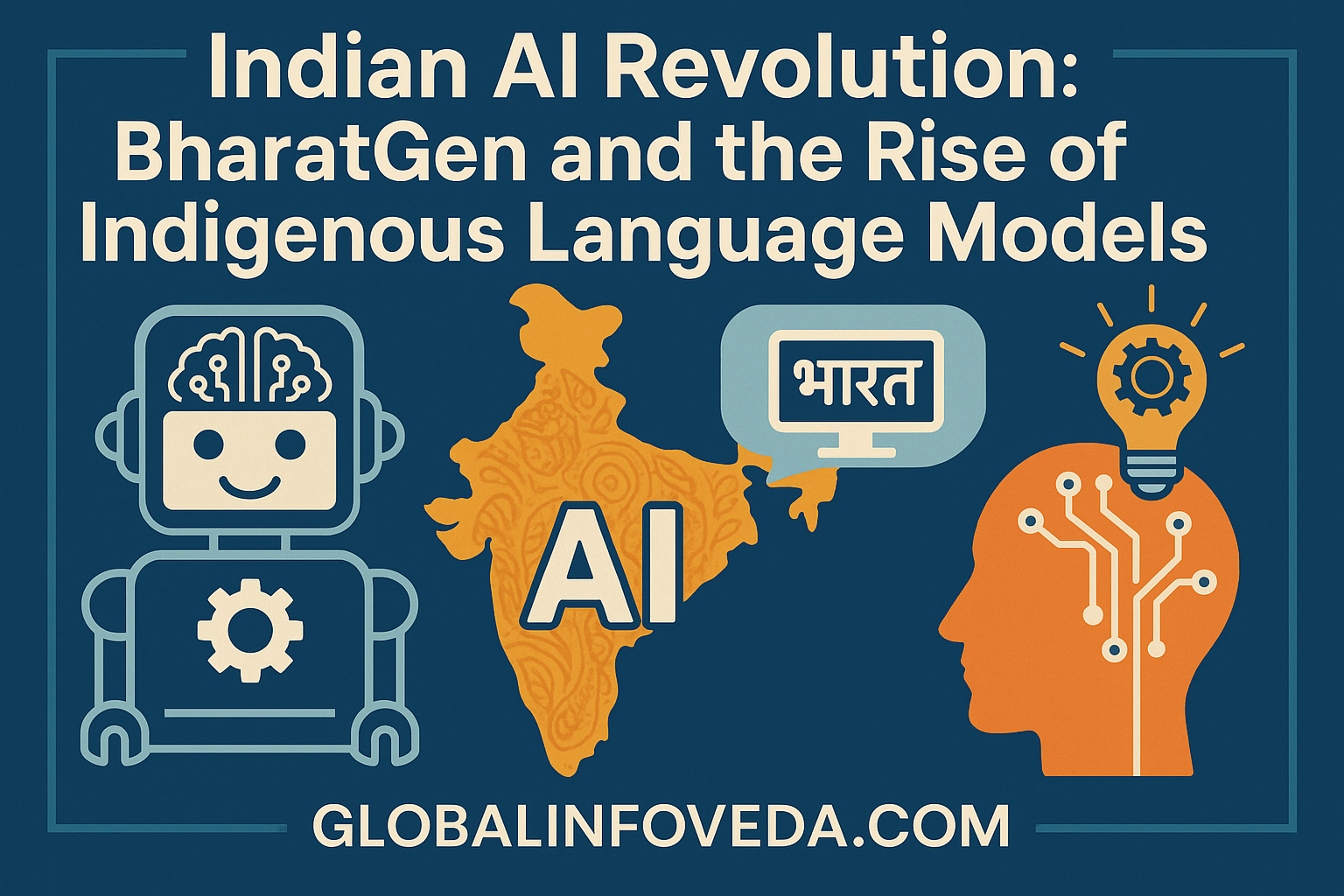
The AI revolution in India (hits delivery store) Now BharatGen – a bid to create indigenous language models that comprehend Indic languages, code mixing and low resource data-grounded facts – has entered a crucial phase. BharatGen‑class models are also different in that they are designed to handle Hindi‑English, Tamil‑English, Bengali, Marathi, Punjabi, Kannada, Malayalam, Assamese, Odia, Gujarati, Urdu, Konkani, etc., in speech, text, and multimodal inputs, unlike imported systems which are tuned for English and Western scenarios. This shift is tactical: sovereign AI, data governance that aligns with Indian law, cost‑efficient inference, and public‑goods datasets that represent the culture of India. This guide lays out the infrastructure, datasets, model architectures, safety, regulatory alignment, and commercial playbooks that underlie BharatGen and the larger emergence of indigenous language models.
Meta description: India’s BharatGen moment: models for Indic languages, code‑mix, affordable inference, sovereign AI, public datasets, safety, and go‑to‑market.
🧭 Why India needs indigenous language models
BharatGen responds to real gaps. Imported LLMs have difficulty with code-switching, dialects, and script variation. In government services, voice assistants have to work with rural accents and bad connectivity. In healthcare the available training data contains clinical notes written in Hinglish or Tamil with English terms. SMEs require chatbots trained on UPI contexts, GST terms and local complaints. Indigenous language models encode cultural priors, respect formalinformal registers and local scripts, enabling inclusion and productivity across sectors.
📈 Demand drivers shaping BharatGen
- 🧠 Digital public infrastructure wants AI that plugs into DigiLocker, Aadhaar flows, UPI, and ONDC catalogues.
- 🗣️ Voice‑first India: immense adoption of ASR/TTS for IVR, ed‑tech, and farmer hotlines.
- 📰 Regional media and creator economy expanding in short‑video and podcasts, demanding captioning and summarisation in local tongues.
- 🏥 Health triage and telemedicine need safe NER, entity linking, and translation tuned to Indian drug names and procedures.
- 🏛️ E‑governance interfaces require explainable flows in plain‑language Hindi and state languages.
🏗️ What makes a BharatGen‑class stack different
Bharat‑Gen is not just one LLM, but a full stack: canon Indian corpora, speech data, tokenisers fair to Devanagari, Bengali‑Assamese, Gurmukhi, Gujarati, Oriya, Tamil, Telugu, Kannada, Malayalam, and Urdu scripts; alignment adapted to Indian norms; cost‑aware inference for Tier‑2/3 hardware; and safety sensitive to local harms and misinformation patterns. The endgame is sovereign AI that can be deployed by governments, startups and enterprises, with auditability and the interoperability with public digital rails.
🧪 Foundation datasets and curations for Indic
- 🔹 Text corpora from state portals, court judgements, Parliament Q&A, and local news with bias checks.
- 🔸 Code‑mixed social media scraped ethically with privacy filters and de‑identification.
- 🔷 Parallel corpora for translation among Indic ↔ English and Indic ↔ Indic pairs.
- 🔶 ASR/TTS speech with age, gender, region balance; telephone‑band and far‑field mics.
- 🟩 Special domains: agriculture advisories, health pamphlets, banking FAQs, GST circulars, UPSC prep content.
🧩 Tokenisation and scripts that respect India
Having a Unicode coverage is not sufficient to address tokenisation. BharatGen needs tokenisers like the one in sentencepiece that handle akshara unit sensibly, preserve maatras and handle nukta forms. In the case of Urdu, the righttoleft sequencing should be managed to cater to diacritics. For code‑mix, joint vocabulary reduces fragmentation so Hinglish phrases will not explode the token counts. Useful tokenisation reduces context costs, speeds up inference and boosts the accuracy on morphologically rich languages.
🧮 India vs global approach to multilingual AI
| Approach | Strength | Limit |
|---|---|---|
| BharatGen (Indic‑first) | Deep code‑mix handling, script fidelity, regulatory fit | Needs GPU scale and long‑term funding |
| Global multilingual | Wide coverage, mature tooling | Shallow on dialects, poor vernacular safety |
| Translation‑proxy | Fast bootstrapping via English hub | Lossy nuance; harms colloquial accuracy |
⚙️ Architectures that fit India’s constraints
- 🧰 Sparse Mixture‑of‑Experts to route code‑mix and dialects efficiently.
- 🔧 Encoder‑decoder stacks for translation and summarisation between Indian languages.
- 🧩 Constrained decoding with lexicons for banking, health, governance.
- 🧲 Retrieval‑augmented generation using government gazettes, schemes, FAQs.
- 🧊 Quantised inference and LoRA fine‑tunes so startups can deploy on edge GPUs.
🧠 Safety, cultural alignment, and evaluation
It is important that Indigenous language models adhere to Indian social norms and laws. Safety layers constituting other amounts are toxicity filters tuned to Indic slurs), election-season misinformation detectors, and religious sensitivity red‑flags. For evaluation, we need benchmark sets in each language for reading comprehension, reasoning, NER, ASR WER, and TTS MOS — plus some code mix stress tests.
🧭 Data governance and trust
- 🛡️ Consent‑respecting pipeline for public and private data.
- 🔐 De‑identification of PII under emerging Indian privacy norms.
- 📜 Clear provenance tags to enable audits and lawful re‑use.
- 🧰 Differential privacy or federated fine‑tunes for sensitive domains.
- 🧪 Model cards and dataset statements published in Indian languages.
🏢 State capacity and public digital rails
India’s public digital infra: Aadhaar, UPI, DigiLocker, ABDM, ONDC, FASTag create backbone for BharatGen deployments. At scale, vernacular AI can be delivered over the voice, and chat layers deployed over state portals, citizen helplines, district kiosks, etc. Procurement should be biased towards open standards, portability, and contestability to avoid lock‑in and create an ecosystem of vibrant small and medium sized companies and startups.
🧪 Case study — vernacular customer support at a PSU bank
One of the country’s largest PSU bank designed a BharatGen‑tuned assistant in relation to IVR and chat in Hindi and Bengali. ASR: trained on call‑centre audio with noise augmentation; NER: with the treatment of IFSC, account types, and UPI mandates. The model passed hallucination checks by enforcing retrieval over policy PDFs. Average handling time decreased 27%; first‑contact resolution increased 18%; and complaints at the tier‑3 level fell.
🏥 Case study — clinical intake triage in Hinglish
A hospital network piloted Hinglish intake. The ASR captured symptoms in mixed Hindi‑English, mapped to SNOMED entities, and produced a quick English summary for doctors. A safety layer blocked dosage suggestions and routed to a human when uncertainty rose. The result: shorter queues, better triage, and fewer missed follow‑ups.
🗣️ Speech frontiers: ASR and TTS for India
- 🎙️ Telephone‑band ASR tuned for rural accents and code‑mix.
- 🗣️ TTS with expressive prosody for female and male voices per language.
- 📞 Noise‑robust models for call‑centre and public address systems.
- 🧏 Accessibility: captions in regional languages for education and news.
🧮 Cost engineering and inference economics
BharatGen prioritizes on minimized latency and cost. With int8 quantisation and as low as 4‑bit options, a mid‑sized model can handle banking chat on a single A100 with a daily sessions rate in the thousands. LoRA adapters allows each business to customise (without copying) the base model. The footprint of the models can be greatly reduced through caching and distillation while still allowing edge deployment within telecom cabinets or a district data centre.
🔌 Compute clusters and energy reality
- 🏭 GPU parks regionally distributed to cut latency and support data residency.
- ⚡ Green energy PPAs to offset training carbon and stabilise costs.
- 🧊 Liquid cooling and rack density constraints in tropical climates.
- 🛰️ Edge POPs near state data centres for citizen‑facing inference.
📊 India’s open vs closed model landscape
| Model class | Benefit | Risk |
|---|---|---|
| Open‑weights Indic | Transparency, fine‑tune flexibility | Model misuse, weight leakage |
| API‑only | Easy start, strong guardrails | Vendor lock‑in, high TCO |
| Hybrid | Control + managed safety | Integration complexity |
🧭 Sector playbooks where BharatGen shines
Indigenous language models unlock adoption in:
- 🏛️ Citizen services: scheme discovery, grievance flows, land records.
- 🏥 Healthcare: intake summaries, discharge language conversion, patient education.
- 🏫 Education: vernacular tutoring, exam prep, content simplification.
- 🏦 Banking: KYC clarifications, GST help, UPI dispute guidance.
- 🛒 Commerce: ONDC catalog normalisation, seller onboarding, returns advice.
🧪 Alignment with Indian law and policy
- 📜 Data protection alignment with emerging Indian privacy regime.
- 🧭 Platform accountability for deepfakes and harmful synthesis.
- 🧪 Risk tiers for biometric, health, and financial use cases.
- 🧰 Audit trails and event logs that regulators can review without seeing PII.
🧠 Benchmarks that actually matter in India
- 🧩 Code‑mix QA: reading comprehension with Hinglish passages.
- 🧪 Indic NER for government and financial entities.
- 🗣️ ASR WER per state and accent band.
- 🧬 TTS MOS with local judges and blind tests.
- 📚 Curriculum tuning for K‑12 textbook language.
🧭 Building a responsible data pipeline
BharatGen teams should approach ‘data stewardship’ as a ‘first‑class’ product. Each clip is tagged with its provenance, license and consent to be used. Red‑teaming investigates local harms — communal tensions, gendered slurs, formats for misinformation — and works patches into place. Synthetic is used thoughtfully but never to flood low‑resource dialects. Testing and evaluation should not be only in form of academic tasks but Indic directives and search queries included.
🧑🏽💻 Startup playbook: from idea to pilot
- 🚀 Pick a narrow vertical (e.g., insurance claims) and collect domain utterances.
- 🧱 Start with a base Indic model; augment with a RAG index of policy docs.
- 🧪 Add guardrails with validators for factuality and privacy.
- 📈 Ship a closed beta to 50 users; track latency, helpfulness, escalations.
- 💳 Prove ROI in one process metric (AHT, FCR, CSAT) before expanding.
🏛️ Government playbook: service at population scale
- 🧩 Standardise APIs so different agencies can swap models without rewrites.
- 🧭 Build fallbacks to human officers and preserve appeal rights.
- 🛰️ Use edge inference at district data centres for resilience.
- 🧾 Publish transparency reports on usage and failures in state languages.
- 👥 Fund speech data collection with rural representation.
🧠 Enterprise playbook: safe deployment in BFSI and telco
- 🔐 Classify intents that should never be answered generatively (balances, passwords).
- 🧲 Route such intents to deterministic workflows.
- 🧪 Maintain gold QA sets in Hindi and state languages for regression checks.
- 🧰 Fine‑tune via LoRA; keep base weights unchanged for safety updates.
- 🧾 Record audit trails for each response with input hashes and doc IDs.
🧭 Talent and research clusters to watch
Indian cities such as Bengaluru, Hyderabad, Chennai, Pune, the Delhi‑NCR region are emerging potential hubs for ASR, NLP, and multimodal work. University labs collaborate with startups for training on speech corpora, OCR for degraded scans and layout‑aware models for Indian scripts. Expect cross‑pollination with robotics (warehousing in Hindi/Telugu) and agri‑tech (advisory bots in Marathi/Kannada) and health‑tech (triage in Bengali/Odia).
🧩 Case study — call‑centre transformation in a telco
A telco operator built BharatGen, created for Tamil, Telugu and Hindi languages. A router sensed intention and language; RAG on price plans reduced hallucinations; speech diarization to tackle agent vs consumer; QA dashboards displayed silences gaps and cross talk. Post roll-out, complaint closures increased by 22% and the agent onboarding time reduced (as the assistant coached them on compliance language in real time).
🧰 Practical evaluation suite for Indic deployments
- 🧪 Factuality via retrieval checks on scheme databases.
- 🧠 Helpfulness judged by bilingual raters.
- 🛡️ Safety flags for harassment, communal content, and medical/legal advice.
- 🗣️ WER slices by district; MOS with local panels.
- 📈 Business impact: AHT, FCR, CSAT, deflection, NPS.
🧭 Interop with Indian digital rails
BharatGen should respect standards used by Aadhaar e‑KYC, DigiLocker verifications, ONDC product schemas, and ABDM health records. Secure RAG over these stores enables assistants that can retrieve, explain, and document actions under proper user consent. Design for offline tolerance and SMS/IVR fallbacks.
🧠 My analysis — why BharatGen is inevitable
Inevitable—because demand is vernacular, policy prefers sovereign AI, compute is cheapening, and tooling is maturing. The next couple of years will be best to those teams that code‑mix well, invest in speech, and release authentic model cards. The winners will not be the players with the biggest parameter counts, but the best alignment, data lineage, and unit economics that work at Indian price points.
SEO & AI Merge—The New Ecosystem Shaping Content Reach in 2025
📚 Open‑source vs paid APIs for Indic builders
| Choice | Best for | Trade‑off |
|---|---|---|
| Open‑weights Indic base | Fine‑grained control, edge deployments | More MLOps, safety burden |
| Managed API | Quick pilots, guardrails | Cost, lock‑in, limited custom vocab |
| Federated hybrid | Sensitive data, local compute | Integration complexity |
🧩 Coping with code‑mix: training and inference tactics
- 🧠 Joint subword vocabularies across English + Indic scripts.
- 🧩 Language‑aware adapters that activate per script cluster.
- 🔁 Synthetic code‑switch generation constrained by grammar templates.
- 📚 Curriculum from pure Indic → code‑mix → noisy inputs.
- 🧪 RAG that normalises product names and scheme acronyms.
🗂️ Domain‑specific lexicons that matter
- 🏦 UPI, NEFT, IMPS, GSTN, PAN, Aadhaar.
- 🏥 ABHA, SNOMED, ICD‑10, brand‑generic drug pairs.
- 🏛️ PM‑KISAN, PDS, Ayushman Bharat, MNREGA.
- 🛒 ONDC categories and attribute hints for catalog cleaning.
🧭 Content and creator economy impact
BharatGen will fuel vernacular creation — from voice‑to‑blog, to captioning, to translation and content planning, attuned to the regional calendars and festivals. Look out for podcast tooling for Indian languages, AI dubbing for OTT, and education creators re-using English content for Hindi, Tamil, Telugu and Malayalam. That broadens reach, ad inventory and the SMB opportunity.
AI Overviews Rule SERPs—How to Get Featured When Clicks Disappear
🧰 Procurement and TCO reminders for CIOs
- 💰 Price beyond tokens: count latency, SLA, data residency.
- 🧪 Demand eval packs in Hindi + state languages.
- 🔒 Insist on deletion promises and on‑prem options for sensitive flows.
- ⚙️ Ask for LoRA‑level customisation and adapter portability.
- 🧾 Bake audit fields into the response schema from day one.
🧭 Education and skilling flywheel
Polyglot India needs AI skilling that includes NLP, ASR, TTS, RLHF, and safety. Colleges should run hackathons on speech corpora, while industry sponsors fellowships for tokenisation research and code‑mix evaluation. Upskilling frontline workers—bank tellers, field officers, nurses—to use vernacular assistants will deliver near‑term productivity gains.
First‑Hand Expertise—Why Personal Experience Is SEO Gold in 2025
🧩 India’s multilingual UX patterns
- 🔁 Language toggles that preserve state across flows.
- 🗣️ Voice preference remembered; fallback to tap.
- 🧭 Clear romanisation aids for names and addresses.
- 🔉 Read‑aloud for low‑literacy audiences.
- 🧪 A/B tests per state; never assume Hindi is universal.
🧭 Financing and grants
- 🏦 Priority sector‑like treatment for AI skilling and GPU parks.
- 🧰 Grants for open datasets and benchmarking in Indic.
- 🧪 Vouchers for SMBs to try BharatGen chat in support.
- 🛰️ State missions to collect speech in underrepresented districts.
🧠 Risks and mitigations
- 🔒 Privacy: build consent screens and PII scrubbing by default.
- 🧮 Bias: measure across gender, caste, region; fix with data.
- 🗳️ Election harms: freeze generation on political topics; route to fact sources.
- 🧰 Hallucination: enforce retrieval, disable free‑form for high‑risk intents.
- 🛡️ Security: defend against prompt injection, data exfil, model theft.
🧭 Intersections with hardware and devices
AI phones, smart speakers, AR glasses, and automotive IVI will ride on BharatGen. With on‑device inference for small models, wake‑word responsiveness in Hindi and Tamil becomes standard. Automotive assistants will understand tolls, FASTag, and route queries spoken in mixed languages, reducing driver distraction.
Voice and AI‑Led Search: How Indians Are Changing How They Google
🧭 Roadmap for BharatGen — 12 to 24 months
- 🧱 Expand speech corpora for low‑resource languages.
- ⚙️ Publish alignment evals for code‑mix harms.
- 🧰 Standardise tokenisers across scripts.
- 🛰️ Bring edge inference to district POPs.
- 🧪 Launch public model cards in Hindi and state languages.
🧩 Ecosystem scorecard
- 🏗️ Compute availability: rising via regional GPU parks.
- 📚 Datasets: growing, but long‑tail dialects remain scarce.
- 🛡️ Safety: improving; needs deeper Indic red‑team culture.
- 🧪 Benchmarks: early; require shared public suites.
- 💸 Funding: better; blended public‑private pools emerging.
India’s Top Five Search Trends of 2025: From ChatGPT to Cricket
🧭 Regional language realities that shift model design
With the caveat that Indic is not monolithic, and each language has its own morphology, phonetics, and orthography which shape our BharatGen choices. In Hindi–English hybrids, nouns and technical words are often left in English but verbs and particles go into Hindi, leading to sequences whose token boundaries need to be handled with care to avoid exploding costs. Tamil has then got agglutination and sandhi rules that penalize stupid subword splits; it works by training tokenisers on literary + colloquial corpora with grapheme span length targets tuned until the model learns morphemes, not noise. Bengali requires the knowledge of dependent vowel signs and conjuncts, or the system will over-segment rare words and artificially inflate OOV performance. Marathi and Gujarati provide colorful accents and numerals on certain forms that are financial-oriented; building OCR and ASR that respects these numerals provides direct benefit in BFSI domain. The lesson is straightforward: if you are building an indigenous language model, it should take script as a first‑class design decision, not an additive afterthought.
🧠 RLHF that respects Indian context
Reinforcement learning from human feedback has a different look when the aim is culturally aligned output. Rater pools must not only have state‑language speakers drawn from several districts — not just metro centres — so that the model can learn the polite form, respectful address for the elderly and language‑specific idioms. Guidelines should prohibit stereotyping and explicitly encode sensitivities around caste, religion and gender. A successful model combines expert raters for high‑risk areas (finance, health, law) with community raters for the humdrum day‑to‑day interaction with the assistant, and mixes them together through reward‑model training. Teams must monitor drift across seasons and train dynamic safety adapters that can be tightened when risks increase.
🧩 Copyright, licensing, and fair‑use guardrails in India
BharatGen pipeline should be pyure from Project designs: Badass scrape only with robots pleasure. txt, steer clear of paywalled content, and try to prioritize things with open licenses (CC‑BY, OD‑blessed) from governments and public institutions. In learning code‑mix from social media samples, de‑identify PII and mask handles. For audio, gather consented speech with clean releases; archival radio and folk recordings can be a rights layer cake. Enterprises should demand provenance tags, ensuring that they can demonstrate the lawfulness of their training when a challenge is made. The moral argument is also a strategic one: trust is a competitive advantage in regulated industries.
🧭 Business models that actually work at Indian price points
Indiginous language models are worth it when monetised against obvious process gains. For BFSI, the value unit is saved minutes per call and reduction of errors in form filling. For telecom, it’s first‑call resolution and churn prevention using proactive tips in local languages. When you’re healthy, time saved at intake means more doctor minutes and greater satisfaction. A common pattern is platform + adapters: sell a BharatGen base as a secure service and provide LoRA adapters per client domain. Bundle RAG with document connectors for policy-compliant search and investigation use‑cases. Keep the total value of the contract small enough for mid‑market companies — and grow by rollout down departments, not marquee but slow mega deals.
🧭 Agri, logistics, and travel — three deep dives
Agriculture is better served when voice bots explain PM‑KISAN, crop insurance, and the weather in local tongues. Incorporate image intake so farmers can submit pest photos; a multimodal classifier funnels these to advice vetted from agro‑university bulletins. The logistics ecosystem depends on vernacular post-POD capture and driver assistants who understand questions in Kannada, Telugu, Marathi about FASTag, e‑way bills, state toll terms and conditions. Travel services can boost conversion with chat that rewrites itineraries in Tamil or Bengali, falls in line with festival calendars and explains visa steps in plain speech. All these applications value code‑mix competence and RAG securely over authoritative docs.
🧭 Red‑teaming India‑specific harms
The safety testing has to encompass guys with axes and rumour-enabled culture clashes and regional slurs. Red‑teamers then ought to attack the assistant with coded phrases and sarcasm and baiting designed to trick it into dispensing disinformation about public health, or elections. Construct block‑lists that generalize over dialectal variants, and verify if prompt injection works in bilingual prompts (“English instruction + Hindi payload”). There should be an entirely separate track for defamation/privacy assurances on citizen‑facing deployments: the safest deployment is the one that doesn’t guess identity, doesn’t attempt to diagnose diseases and divides legal/medical questions from those best answered by verified sources with a strong fine print.
🧭 Investor lens — what a sensible thesis looks like
Sane thesis values teams who show data rights, code‑mix benchmarks, and unit economics more than bloated parameter counts. Preferred signs are working ASR/TTS pair for one low‑resource language, low latency on mid-tier GPUs, and at least two paying pilots in BFSI or telecom. Margins get better as you start reusing the same adapters and RAG indices across clients. Downsides: Reg not believed to be the bane of the GPU industry, GPU supply dearth, talent turn mitigation techniques identified are hybrid deployments and partnership with state‑run infra. The result feels more like enterprise SaaS businesses than ad‑funded consumer applications — put your head down and do some work, and you can build a valuable business with reasonable (and disciplined) growth.
🧭 Edge deployments in railways, retail, and healthcare
Railways can support on‑prem inference as part of their station data rooms Hindi, Bengali, Tamil and Marathi query handling for ticketing and platform change’s runs even when links are down. In-store kiosk companions (who speak the local language) at retail chains explain the offers and gather feedback, easing the burden on the queue of staff. Hospitals operate triage nodes that securely transcribe, translate, and summarize intake on‑site, syncing to the cloud for analytics only. These canary deployments require quantised models, power‑efficient GPUs and good observability to detect drift.
🧠 Multimodal Indic — from OCR to vision‑language assistants
The next frontier is multimodal. OCR optimized for Devanagari, Gurmukhi, Bengali- Assamese and Tamil scripts supplies RAG pipelines images of scanned land records and certificates. vision‑language assistants can read chalkboard signs, pharmacy labels, and bus schedules pair this with TTS to help low‑literacy users at rural kiosks When it comes to public policy, block face recognition by default, and instead concentrate on general object and text comprehension that can improve service without adding to the surveillance state. And done right, multimodal BharatGen opens up whole new levels of access and inclusion.
🧭 From pilots to statewide rollouts — execution realities
Scaling from 10 to 10,000 agents is going to take more than a well‑trained model. Teams need to invest in deployment playbooks: language packs by state, fallbacks to SMS/IVR, and analytics that break out by district and language. The training of front-line staff is non negotiable – scripts must include non offensive address patterns and escalation signals in local languages. Governance should monitor fairness across customer segments and issue half-yearly transparency notes that are in plain Hindi and in state languages. If rollouts are aimed at schools systems or farmer hotlines, then co‑design with local educators and agri‑officers helps to ensure that the expectations are well aligned in the first place.
🧭 Research themes India can lead
India can lead on code‑mix theory, tokenisation for abugidas, low‑resource speech. Indic script OCR error types Benchmarks, Accent‑aware ASR pretraining RLHF instructions not tied to cultural norms would help the global community. A public tournament suite with annual leaderboards for Hinglish, Tanglish, Kanglish, and Banglish would drive improvement. In the meantime, privacy‑preserving finetunes for health and finance might become a blueprint for the Global South.
🧭 What success looks like by 2026
One happy footnote to wrap it up: BharatGen under the hood of PSU helplines, Bhashini datasets grown to long‑tail dialects, GPU parks providing regional capacity with green energy, and an ecosystem of startups selling secure adapters into BFSI, telecom, health, online education. Residents can chat with human-like assistants that can speak back; agents in call centres receive assistive prompts in their own tongue; children in state schools are taught with voice tutoring in Marathi, Tamil or Assamese without language shame. The benefits are prosaic, but powerful — minutes saved, errors down, dignity up.
📚 Sources
- Ministry of Electronics & Information Technology (MeitY) — national AI initiatives and policy briefs: https://www.meity.gov.in
- IndiaAI / Bhashini — multilingual AI mission and datasets for Indic languages: https://bhashini.gov.in
- NITI Aayog — national AI strategy and sectoral policy framing: https://www.niti.gov.in
- Bureau of Indian Standards (BIS) — AI standards and safety guidance (relevant IS documents): https://www.bis.gov.in
🧠 Final Insights
BharatGen isn’t about being bigger than global giants — it’s actually quite the opposite; we’re on a mission to build intelligence that is useful, trustworthy, affordable for Indic languages. The opportunity lies at the intersection of public digital rails, ethical datasets, alignment on local harms, and cost‑engineered inference that can flourish at Indian price points. Teams that embrace code‑mix realities, invest in speech and open up model cards in Indian languages and interop with Aadhaar, DigiLocker, UPI, ONDC and ABDM will create lasting advantage — and power knowledge for hundreds of millions.
👉 Explore more insights at GlobalInfoVeda.com