





🤖 Introduction
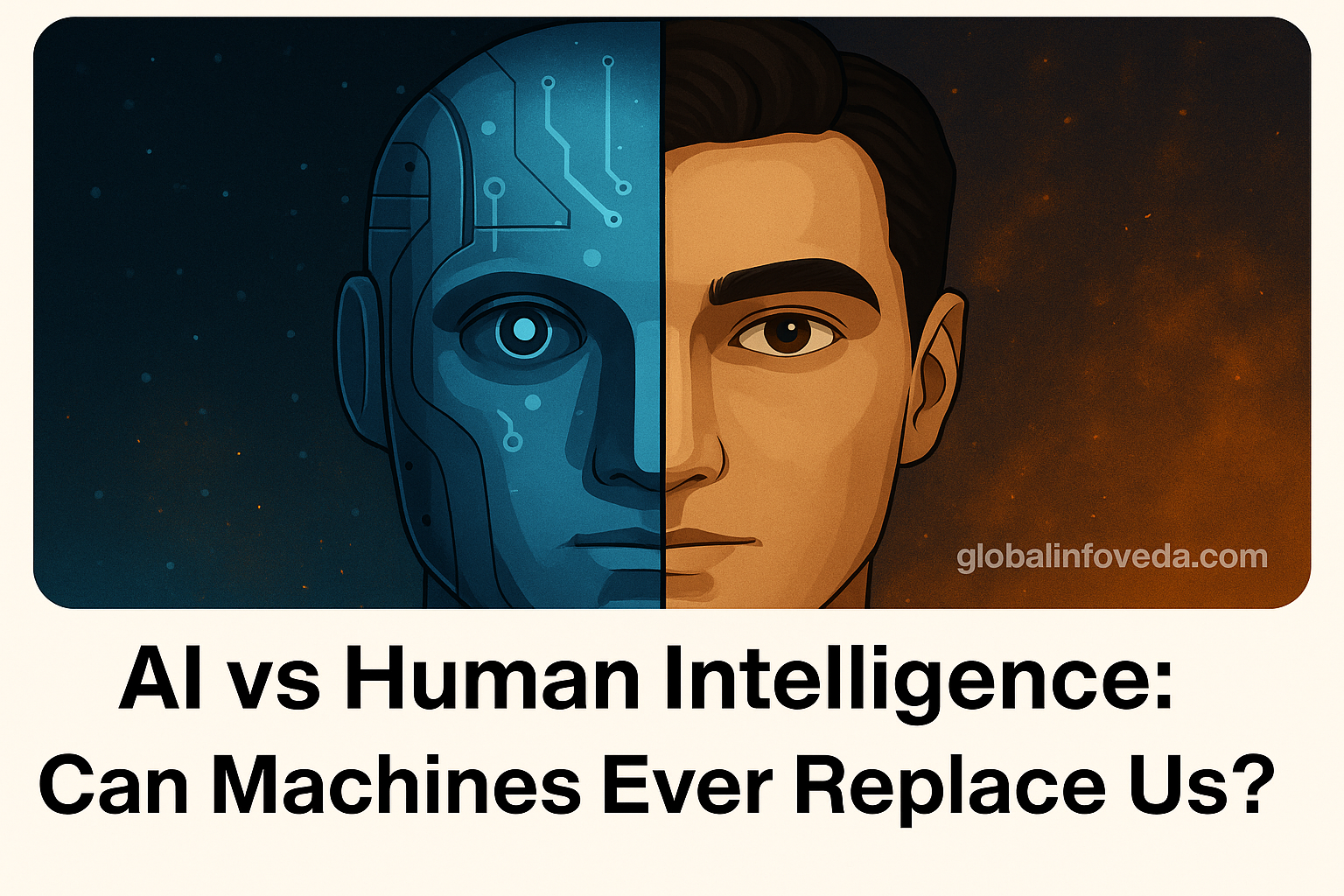
AI has transitioned from the lab to the world — forcing us to confront the pressing question: can technology can ever duplicate or exceed human intelligence? This article explores what “replacement” would look like in cognition, work and society. It also demystifies hype and evidence with a comparison of machine and human strengths (the authors offer two comparison charts) and embeds the conversation in global policy, education, healthcare, and finance. The point is clarity — on where AI is already better than us and where we are still better than AI, and on how human societies can best harness augmentation without sacrificing trust, jobs or dignity.
Meta description: AI vs Human Intelligence. Is AI capable of substituting human brain? A 2025 guide to the world’s strengths, glass jaws and jobs, with charts, FAQs and policy case studies.
🧠 What do we mean by intelligence?
Intelligence is not a single knob. It’s a mash-up of perception, pattern recognition, reasoning, memory, motor control, social intuition, morals, and metacognition. Contemporary AI systems are wickedly good at the narrow competence we’ve set them to: They distill patterns from mountains of data, and they can map inputs to outputs with speed and consistency. Human intelligence is still general and situated. It develops from what we have lived and learned as a result of feedback from our sensory-motor systems, as well as our emotions, and social interactions. The question of whether AI can ‘replace’ humans depends on the task domain, the cost of errors, the amount of embodiment, and social acceptability of automateddecisions. A model that outperforms a human on a benchmark may still need to be overseen, because accountability cannot be delegated to code.
Human intelligence is also morally valuable and narratively realized. People can justify their decisions in patterns that others can challenge, establishing social legitimacy. Even if a computer programme were to achieve human performance, replacement could still be unacceptable in situations requiring empathy, contextual understanding or moral judgement. The superior mental model is complementarity: AI compresses the world; humans understand and steward it.
🧮 Methodology: how we assess replaceability
- 🔎 Scope: Evaluate tasks, not whole professions; rate by predictability, error cost, embodiment, and social acceptance.
- 🧭 Automation vs augmentation: Use automation for structured, low‑variance work; apply augmentation where judgment, explainability, and exception handling matter.
- 🧪 Evidence standard: Prefer real‑world validation, ablation tests, and stress testing over single accuracy numbers.
- 🧰 Governance lens: Require model governance artifacts—data lineage, versioning, monitoring, and recourse for affected users.
- 🌐 Global framing: Compare across sectors and regions; avoid single‑country assumptions.
SEO & AI Merge—The New Ecosystem Shaping Content Reach in 2025
📊 Cognitive strengths—AI vs humans
| Capability | AI strength | Human strength |
|---|---|---|
| Speed & scale | Processes terabytes quickly and consistently | Limited by biology and fatigue |
| Generalization | Strong in‑distribution; brittle out‑of‑distribution | Flexible transfer via reasoning and analogy |
| Transparency | Logs steps but internals are complex to explain | Can justify reasoning and values |
| Adversarial robustness | Susceptible to prompt/data attacks | Detects manipulation via commonsense |
| Embodiment | Needs robotics and careful calibration | Intuitive sensorimotor skills |
🌍 Global case studies: augmentation over replacement
Case study 1 – Retail customer support: A multilingual chatbot handles FAQs in English, Spanish, and Arabic, cutting average handle time by 35%. Complex complaints are routed to human agents with explainable summaries. Outcome: higher CSAT and lower escalations—clear value from augmentation, not replacement.
Case study 2 – Manufacturing quality: Computer vision flags micro‑defects on a packaging line. Human inspectors verify edge cases, while feedback loops retrain the model against new materials. Result: fewer false negatives, higher yield, and a documented model governance trail.
Case study 3 – Clinical triage: A hospital network deploys a decision‑support tool to prioritize radiology follow‑ups. Nurses retain final sign‑off; the system provides explainability notes and risk factors per case. Outcome: quicker care for high‑risk patients without replacing clinical judgment.
AI Devices in 2025: Smart Glasses, Emotion‑Aware Assistants & Health Trackers
🧩 Where AI already outperforms
- 🧩 Pattern recognition at scale: classification, retrieval, anomaly detection in images, audio, logs, and transactions.
- 📈 Prediction where data are abundant: forecasting, fraud scoring, credit risk within monitored ranges.
- 🔤 Language transformation: summarization, translation, entity extraction, and structured data conversion.
- 🔎 Search & synthesis: assisted research, code generation with tests, and data cleaning.
- ⏱️ Endurance tasks: 24×7 monitoring, alerting, and optimization loops where fatigue hurts human performance.
🫀 Where humans still lead—decisively
- 🛠️ Embodied dexterity in unstructured environments: improvising with imperfect tools or shifting context.
- 🤝 Social judgment: reading subtext, negotiating trade‑offs, calibrating tone to culture and history.
- 🧑⚖️ Moral reasoning & accountability: justifying decisions to affected people and accepting responsibility for harms.
- 🔬 Causality with sparse signals: forming new hypotheses when data are limited, messy, or adversarial.
- 🎨 Meaning‑making & creativity tied to lived experience: humour, grief, identity, and cultural nuance.
👷 Jobs and skills worldwide: who is at risk, who is resilient
- 🧾 Routine, rules‑based desk work is most exposed; workflow automation removes steps, not always roles.
- 🔧 Skilled trades (field variability) gain from diagnostics and planning apps; humans handle messy reality.
- 📊 Analytical roles shift toward prompt design, data quality curation, and validation.
- 🎭 Creative and community‑facing work remains resilient where trust and originality matter.
- 🧰 Strategy: skills stacking = domain depth + data literacy + tool fluency + communication.
🎓 Skills stacking playbook
- 🎯 Build domain depth in one field you care about.
- 📊 Add data literacy: spreadsheets, SQL basics, chart reading.
- 🎛️ Practice prompt design and verification habits.
- 🗣️ Strengthen communication in English and one local language.
- 🛠️ Learn an automation or low‑code tool to glue workflows.
Best Free Online Courses with Certificates to Boost Your Career in 2025
📚 Education: from cheating panic to personalized learning
- 🎒 Adaptive tutors adjust pace, style, and language to reduce disengagement.
- 🧑🏫 Teachers use planning assistants to draft lesson plans, quizzes, and rubrics.
- 📝 Assessment shifts toward oral defenses, projects, and real‑world tasks.
- 📜 Institutions publish AI‑use policies distinguishing support vs. ghostwriting.
- 🌐 Equity requires offline‑first tools for low‑bandwidth contexts.
🏥 Healthcare: augment clinicians, protect patients
- 💊 Clinical decision support flags drug interactions; adds explainability and risk factors.
- 🏥 Triage bots in local languages route to the right facility and reduce queues.
- 🛡️ Guardrails: local bias audits, human‑in‑the‑loop sign‑off, and consent for secondary data use.
- 🧪 Safety cases include worst‑case testing against adversarial inputs.
- 🏘️ Rural reach improves only with community health worker networks and reliable logistics.
💳 Finance & governance: accuracy, fairness, and recourse
Financial AI works well with data, feedback loops and supervision: credit, fraud, and collections. But explainability is non‑negotiable. Applicants would get clear‑language reasons plus avenues of appeal. Well-governed models are versioned thingies, without which, there be nothing but chaos, audit logs, challenger models, stress tests and agile monitoring when situations change. Banks, non‑bank lenders and fintechs collaborating bring about innovation together with the necessary consumer protections. At the end of the day, automation is supposed to minimize variance of errors and more towards fair pricing, not a race to the bottom on compliance.
Human Voices vs AI Spam—Why Authenticity Will Determine SEO Winners
⚖️ Task replaceability matrix
| Task category | Replaceability by AI | Why |
| Data entry, transcription | High | Structured, repeatable, low risk |
| Customer triage (first‑line) | High–Medium | FAQ‑like, measurable outcomes |
| Compliance checks | Medium | Rules‑heavy but nuanced |
| Field service, nursing | Low–Medium | Embodied, situational |
| Teaching, counseling | Low | Trust & relationship‑centric |
| Strategy, negotiation | Low | Ambiguity and stakes |
🛰️ Signals to watch in 2025–26
- 🏛️ Public procurement standards for AI will shape markets (auditability, security testing).
- 🖥️ Affordable compute and hosting will determine SME adoption.
- 🔍 Transparency wins trust: publish model cards and plain‑language FAQs.
- ⚖️ Regulatory rulings on automated decisions will clarify appeal rights and liability.
Quantum Computing Breakthroughs: Light‑Based Chips That Could Change AI
🧪 Benchmarks and evaluation pitfalls
Benchmarks can be helpful, but they can lead teams astray, optimizing for the wrong thing. Not everything that works well on a public leader board is safe or useful to use in practice. Treat test sets as the posing of proxies, not of truth. Validate with holdout cohorts that closely resemble your users, and measure calibration (does the system know when it is uncertain?) alongside accuracy. It would introduce abstention thresholds so that the system can hand off to people when confidence or context is poor. Track data drift and prompt‑injection resilience directly; a system that is doing well on yesterday’s distribution may slowly fail as the world changes. Compare with a realistic human baseline—not an ideal, unemotional expert who can spend unlimited time, but conditions your staff actually work in.
🧱 Data quality, provenance, and documentation
The most cost-effective way to upgrade an AI system is often better data. Spend on provenance (where data came from and under what consent), labeling quality, and sampling that reflects how it’s going to be used in reality. The leak: if you have outcomes on the training set predicted by a previous model, you may encode a shadow of what the previous model saw. Reference datasheets for data sets and model cards for model reporting to document characteristics of data sets and known failure modes, as well as assumptions and intended uses. When necessary, create synthetic data to capture the extreme cases that have rare but high impact —and then ruthlessly test those cases. Develop observability for inputs, outputs, and user interventions so you can learn in production without violating privacy.
💰 The economics of compute
Fine models are of no good in production, if heavy inference cost and latency are not considered. Control spend with caching, retrieval‐augmented generation for grounding, and distillation into smaller assistants for common paths. Use quantization and batching to reduce cost, and tier SLAs to the importance of the work so you can route low-urgency traffic to more cost-effective stacks. Try on‑device or edge inference to protect privacy and ensure responsiveness. Think of token budgets, context windows, autoscaling limits, as product constraints and not infrastructure trivia. Your objective is anticipated unit economics per task so the ROI is positive as usage grows.
🗺️ 30–60–90 day enterprise plan
For the first 30 days, do discovery: map priority workflows, identify pain points and create guardrails (what the system should never do). In 60 days ship one to two pilots with measurable success and a human‑in‑the‑loop process for exceptions. Develop data model governance (owners, datasets, monitoring) and conduct a basic red team around security and bias. Day 90: Harden the stack: Automate evaluations as you harden the stack, add feedback loops, train staff and publish plain language FAQs for users. Keep scale in check; push for one well‑governed assistant that actually saves time over five demos that lower trust.
🛡️ Risks and safeguards
- 🧬 Data quality debt: poor labels and sampling bias propagate harm; invest in curation.
- 🔐 Security: prompt injection, data exfiltration, model inversion; require red‑team testing.
- ⚠️ Over‑reliance: automation complacency hides silent failures; keep human sign‑off.
- 🌱 Environmental costs: right‑size models, cache intelligently, batch jobs for efficiency.
- 🧾 Accountability drift: define responsibility in contracts; create user recourse.
🧭 Personal analysis: will machines replace us—or refocus us?
“Replacement” is the wrong metaphor. The durable gains come when A.I. remakes the production function: fewer repetitive steps, more time for judgment, empathy, originality. In markets, the true edge is culture — trust established via language, community connections and service norms. Winning companies marry end-to-end model governance with human‑centered design, rather than investment in one at the expense of the other, and train the frontline to treat AI as a teammate, not a boss. The future of work is less man vs machine and more man with machine vs man without.
❓ FAQs
- ❗ What’s the biggest mistake with AI? Treating it as a drop‑in replacement rather than redesigning workflows around augmentation and governance.
- 👷 Which jobs change first worldwide? Back‑office processing, contact‑centre triage, junior analytics, and content localization.
- 🎨 Can AI be creative? Yes at remix and surprise; human lived experience still drives meaning.
- 🎓 How should students prepare? Build data literacy, prompt design, verification habits, and bilingual communication.
- 🏥 Is AI safe in healthcare? Yes with bias testing, consent, explainability, human sign‑off, and clear accountability.
🔎 References
- World Health Organization – Guidance on the ethics and governance of large multimodal models in health (2024). https://www.who.int/news/item/18-01-2024-who-releases-ai-ethics-and-governance-guidance-for-large-multi-modal-models
- OECD – Employment Outlook 2023: Artificial intelligence and the labour market. https://www.oecd.org/en/publications/oecd-employment-outlook-2023_08785bba-en.html
- NIST – AI Risk Management Framework (2023). https://www.nist.gov/itl/ai-risk-management-framework
- UNESCO – Recommendation on the Ethics of Artificial Intelligence (2021). https://www.unesco.org/en/artificial-intelligence/recommendation-ethics
🔚 Conclusion
Artificial intelligence already wins in speed, scale and pattern recognition; humans win in curiosity, creativity and a generalization of knowledge. The winning recipe is augmentation: design work so that AI handles data‑dense and repetitive tasks while humans focus on the relational, the ambiguous and the accountable. For societies, that calls for investing in skills, guardrails and equitable access so the benefits compound widely, not narrowly.
👉 Explore more insights at GlobalInfoVeda.com