







🤝 Introduction
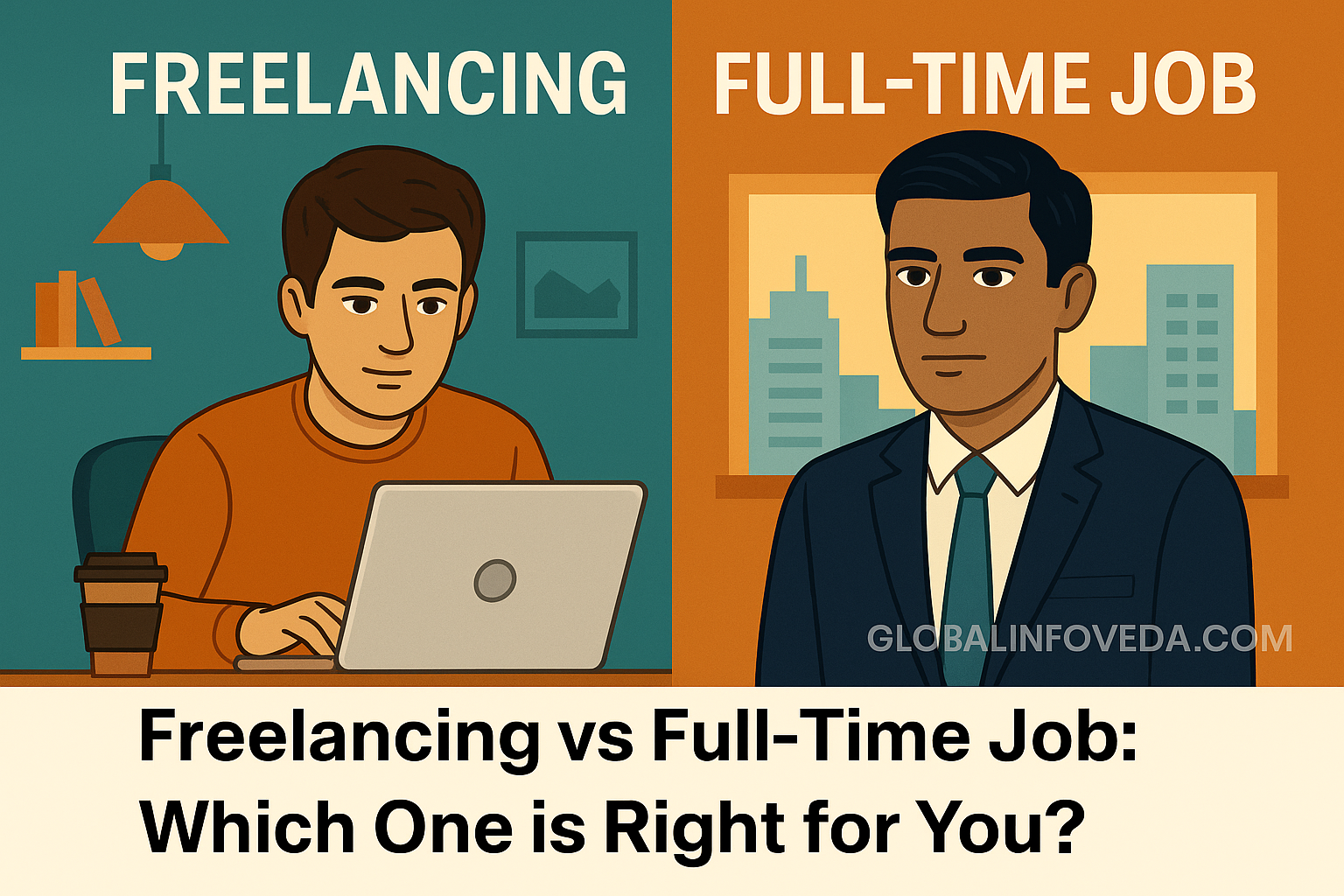
Freelancing vs full‑time job is no longer just a pay vs security trade‑off. In 2025, Indian employees measure flexibility, benefits, tax compliance, career growth and mental health alongside headline salary. This deep dive demystifies the realities of both routes — how money really flows, what risks are worth worrying about, how to safe-proof yourself, and what to do if you can’t decide and want a little bit of both. You’ll also find action‑oriented playbooks, 2 comparison charts with 3 columns each, 3 real‑life case studies, and an FAQ to gain confidence in your selection. The discussion of freelancing vs full-time job has never been more relevant.
Meta description: Explore the comparison of freelancing vs full‑time job in India 2025. Stack up money, benefits, taxes, risks, lifestyle and growth against other career options with charts, playbooks and case studies.
🎯 How to decide in 10 minutes
The fastest way to clarity is to evaluate your needs across money, time, and stability.
- ✅ Cash runway (6–12 months): If you lack an emergency fund, full‑time may fit until you build one.
- 💼 Portfolio vs title: If your industry rewards visible projects more than titles, freelancing accelerates proof of skill.
- ⏱️ Schedule control: If you need flexibility for caregiving, studies, or health, freelancing wins.
- 🛟 Benefits requirement: If you rely on health cover, paid leave, or an EPF track, full‑time is safer.
- 💰 Upside appetite: If you want income to scale with effort and negotiation, freelancing has the higher ceiling.
- 🧠 Learning path: If you want structured mentorship and formal L&D, a good full‑time org compounds faster.
Best Free Online Courses with Certificates to Boost Your Career in 2025
📊 Money, stability, lifestyle
| Dimension | Freelancing | Full‑time |
|---|---|---|
| Income pattern | Variable; project‑based; room to scale | Fixed salary; predictable cash flow |
| Stability | Depends on pipeline and client concentration | High; backed by benefits and payroll |
| Lifestyle | Flexible hours; location independence | Structure; team rituals and clear boundaries |
🧾 Taxes and compliance basics
While taxes seem simple on a payroll and more like integrated business operations when working on freelancing. On salary earned on a full‑time job, the employer takes care of TDS, deposits EPF/ESI if applicable and gives Form 16, so your return is largely a reconciliation. As a freelancer, you send invoices and track receivables, and keep a clean ledger of income and deductible expenses (hardware, software, internet, co-working, and professional fees). Cross the GST threshold and you will have to register, file returns and maintain client-wise records.
The cash‑flow reality is advance tax falls due quarterly, and to underpredict income is to spare a year‑end thrash. Keep business and personal accounts separate, categorize every transaction and schedule a 15‑minute review once a week. We’re not doing all this to end up being an accountant, but I want clear numbers so my pricing and my savings and my investments are intentional.”
And finally, it’s leverage: Standardized scope contracts, milestone‑based payments, and consistent UPI/NEFT descriptors make audits and loan applications a breeze. Even just one hour with a CA to set up your template stack can generate a payoff in minimizing mistakes and making better deductions.
🛡️ Benefits that actually matter
The longlasting career is made of silent protections. Health insurance protects against medical shocks; full‑time plans generally offer family riders and cashless networks, whereas independents should opt for an individual/family floater plus a low cost personal accident add‑on. The compounding on retirement contributions is higher than that on most promotions: salaried employees are enrolled in EPF/NPS by default; freelancers can self‑contribute on NPS and automate index‑fund SIPs so that savings happen on autopilot. Work-Life Balance and Financial Survival: Issues that Independents, Agencies and Organizations Need to Address Paid time off supports mental health; independents should bake downtime into retainers and schedule recovery weeks.
You also have a good credit profile. Loans and rentals are more valuable when income is steady, so does payroll alleviate them. They can make up for that by having two‑year ITR history, a higher security deposit and stable banking flows. Consider benefits to be a component of total compensation, rather than an optional add-on; the route you take needs to be able to address these components intentionally.
🧩 Skill growth and career capital
What accumulates over a decade is not money but career capital — a store of rare and valuable skills, relationships and human capital able to command and control very valuable resources. In a high calibre full‑time environment you receive formalised mentorship, brutal code/design reviews, and cross‑functional projects that impart scale and systems thinking. It’s hard to produce that kind of depth by yourself.
As a freelancer, you learn negotiation, scoping, client empathy, quickly, and you build a public portfolio across many domains. Diversity heightens judgment, but you must design your own learning plan — courses and communities and deliberate practice. Some people shift between stages: diving deeply into a team to level up, then branching out to widen exposure and income. The best plan is whatever allows you to build skills at a manageable rate without burning out.
🧮 Cost anatomy (monthly)
| Cost head | Freelancing (typical) | Full‑time (typical) |
|---|---|---|
| Taxes & compliance | Advance tax, accounting tools | TDS handled; minimal admin |
| Benefits | Self‑funded health, NPS, leave buffer | Employer health, EPF/NPS |
| Work tools | Laptop, software, coworking | Tools usually provided |
🧠 Case study: early‑career engineer in Bengaluru
A 24-year-old software engineer who has been on the job for 18 months is looking for accelerated learning. They’re weighing full-time leap to a product team with strong mentors vs jumping for freelance. Having mapped skills, they uncover missing layers of system architecture and of test coverage a senior‑heavy team can fix rapidly. Decision: join the team for 12–18 months to get some depth (get it? like a pool), then spin a nights‑and‑weekends freelance practice specializing in writing automation scripts for startups. Result: portfolio expands with taps impact stories and paid items.
🧠 Case study: mid‑career marketer in Pune
A brand strategist, 32, is tired of strict schedules and craves location freedom. They specialize in B2B positioning and LinkedIn ghostwriting, charge monthly retainers, have UPI/GST compliances in place. Three months in, two retainers equal salary; month four adds a website refresh. Admin Fridays for invoicing and pipeline is also on their schedule. Result: Increased autonomy and leverage that scales — but with careful risk buffers.
🧭 The balanced option
You don’t have to have one identity for all time. A practical blend is a solid full‑time position that pays the bills and a slim freelance lane that expands you. Keep the side lane narrow — one offer, one niche, one night a week — so you don’t lose quality of life. Be mindful of outside‑work clauses in your employment contract, avoid client conflicts, and keep hours clean. You can lean a little harder toward independence or you can double down on the team after 6 to 12 months of real data on energy, income and similar. Consider it a barbell, one that hedges risk while compounding career capital.
🧰 Pricing frameworks you can copy
- 💰 Value‑based: price against outcomes (e.g., per lead, per conversion uplift).
- 🕒 Day‑rate: set a floor for context switching and meetings; limit half‑days.
- 📦 Productized: sell fixed‑scope packages (e.g., “3‑page site + GA4 + SEO basics”).
- 🔁 Retainers: smooth cash flow; include SLAs and clear deliverables.
🗂️ Proposal to payment flow
- 🔎 Discovery → capture goals, constraints, and success metrics.
- 🧾 Scope → define deliverables, timeline, and assumptions.
- 📜 Contract → include IP, revisions, payment milestones.
- 💳 Invoicing → advance retainer; milestone UPI/NEFT payments.
- 🔍 Retrospective → document results for your portfolio.
🧱 Risk map and hedges
- 📉 Pipeline dips → build a 3‑month runway, nurture referrals, keep an email list.
- 🧑⚖️ Scope creep → change‑order clause, per‑sprint caps.
- ⏱️ Time theft → time‑boxed standups, meeting agendas, async updates.
- 🔐 Data security → NDAs, separate workspaces, password managers.
🌐 Where work comes from now
- 🤝 Warm referrals from past bosses and colleagues.
- 🧵 Niche communities (no‑spam channels) on Slack/Discord.
- 📝 Authority content: practical posts, teardown threads, short case studies.
- 🔍 Search: rank for “freelance [skill] India” and “[city] consultant”.
SEO & AI Merge—The New Ecosystem Shaping Content Reach in 2025
🔧 Tool stack for independents
- 📅 Calendar + booking links for frictionless calls.
- 📁 Cloud docs + project boards for client visibility.
- 🧮 Invoicing + UPI + accounting for compliance.
- 🛡️ Password manager + MFA for security.
- 🧠 Knowledge base for SOPs and templates.
🧠 Mindset and mental health
Sustainable careers are about boundaries, rest and honest evaluation. In full‑time jobs, defend nights, spend PTO, and batch notifications so that deep work can survive. Psst: As the lone wolf, pace deliveries, define office hours, build small peer circles to replace water‑cooler support. Both paths benefit from weekly check‑ins: what worked, what drained energy, and what system to tweak. Ambition without recovery is churn; recovery without ambition is stall. Calibrate both, if you can, so that you can play a long game.
📊 Career capital flywheels
| Lever | Freelancing | Full‑time |
|---|---|---|
| Reputation loop | Fast portfolio growth, public proof | Internal impact stories, formal titles |
| Learning loop | Diverse domains, client constraints | Deep systems, strong mentorship |
| Opportunity loop | Inbound via content/referrals | Promotions, rotations, leadership tracks |
🧭 Remote and visas
The geography of work continues to fray. Freelancing integrates itself well with remote clients and geo‑arbitrage, earning in a stronger currency and spending it in India. Some countries are now issuing digital‑nomad visas, but paperwork counts: get your head around tax residency, double‑taxation agreements and health cover abroad before you jump on a plane. Hybrid is also common at Indian companies; consider the value of in‑office mentorship early in your career against the savings from not commuting. The ideal balance is the one that maximizes for real learning per hour while keeping life logistics as simple as possible.
🧪 90‑day switch plans
- 🔄 Job → freelance: build runway, pre‑sell two retainers, set up compliance, and resign only after signed LOAs.
- 🔄 Freelance → job: curate case studies, target roles that value ship speed, and prep stories using STAR.
🧭 Interview and negotiation notes
- 🧑💻 Full‑time: quantify impact (revenue saved/earned), ask about L&D budget, mentors, and roadmap.
- 🤝 Freelance: open with discovery, steer to outcomes, and price the delta you create—not your hours.
🧩 Common myths
- ❌ “Freelancing is unstable, jobs are safe.” Risk exists in both—firms restructure, clients churn. Build buffers and pipelines.
- ❌ “Freelancers earn less.” Top independents out‑earn peers via retainers and productized offers.
- ❌ “Jobs kill creativity.” Great teams can be creative engines with real feedback loops.
❓ FAQs
- How big should my emergency fund be? Aim for 6–12 months of expenses if you freelance; 3–6 if salaried.
- What if I like both? Run a barbell: keep your role and take one freelance client that builds a new skill.
- Which pays more long‑term? Depends on negotiation, leverage, and deal flow; freelancing has higher variance.
- How do I avoid burnout? Price realistically, systemize onboarding, and schedule no‑meeting blocks.
💸 Compensation structures decoded
Compensation is not just the sticker price or the project fee; it is the system behind the cash. In a robust full‑time offer, CTC will cover basic, HRA, allowances, employer EPF, possibly gratuity, insurance; what hits your bank each month as ‘in‑hand’ post TDS and employee contribution. Annual bonuses, variable pay and ESOPs come on top of this, usually with performance and vesting conditions. Quiz the mix: a bit lower fixed plus a good L&D budget and strong mentorship > a higher but leaner CTC.
For freelancers, the headline project fee obscures actual costs: non‑billable time (sales, scoping, revisions), software, hardware, taxes and the downtime between gigs. Treat yourself as a small studio: plan for a utilization rate – let’s say 60-70% of hours actually billable, price in runway and benefits you fund yourself, and prefer retainers for predictable cash flow. The proper contrast isn’t paycheck vs. invoice — it’s total compensation vs. total economics — including growth velocity and survivability during lean quarters.
🧮 Rate calculator (copy/paste)
- 🎯 Set target annual income (post‑expense): e.g., ₹12,00,000.
- 🧮 Add annual business costs (software, gear, coworking, internet): e.g., ₹1,20,000.
- 🛡️ Add benefits budget you’d have on payroll (health cover, time off, upskilling): e.g., ₹1,20,000.
- 🧰 Total pre‑tax requirement = ₹14,40,000.
- ⏱️ Available work hours/year = 48 weeks × 25 billable hrs/week = 1200 hrs (assume 60–70% utilization).
- 💸 Base hourly = ₹14,40,000 ÷ 1200 ≈ ₹1,200/hr.
- 📦 For fixed‑scope projects, multiply hours by 1.2–1.4 to cover revisions and meetings; round to a clean project price.
- 🔁 For retainers, set a day‑rate floor (e.g., ₹9,000/day) and sell outcomes, not hours.
⚖️ Legal and IP must‑haves
- 📝 Scope: deliverables, acceptance criteria, and out‑of‑scope clearly listed.
- 💳 Milestones: advance to book the slot; mid‑point; final on acceptance.
- 🔐 Confidentiality: NDAs, data handling, and deletion timelines.
- 🧠 IP: who owns what, when rights transfer, and portfolio display rights.
- 🔄 Change orders: written approval for new work; rate for extras.
- 🛟 Termination: notice period, payment for work‑in‑progress.
- ⚖️ Governing law and dispute venue spelled out.
🤝 Network building that feeds pipeline
Good careers — job or freelance — run on trust loops. Begin with the inner circle (ex‑managers, teammates, classmates): an easy, quarterly check‑in with a tight update (what I’m learning, where I can help, one ask) compounds faster than blind outreach. Amass authority by shipping small, useful artifacts (checklists, teardown threads, mini‑case studies) that solve common problems in your niche. Join no‑spam professional communities where people trade feedback, not just links; answer questions generously, then sweep them into reference posts. And finally, keep a lightweight CRM (even just a spreadsheet) for keeping track of conversations, follow‑ups and mutual introductions. Whether you go the full‑time ladder or the freelance runway, a warm network is the resource that paves transitions and fills calendars.
🔎 References
- Ministry of Labour & Employment, Government of India – social security codes and worker protections.
- International Labour Organization (ILO) – reports on platform/gig work and labour trends.
- NITI Aayog – assessments of the gig economy in India (2022 onwards).
- OECD / World Bank – employment outlooks and productivity studies.
🧠 Final insights
The “right” choice is the one that builds up your career capital without destroying your health or finances. If you need structure, benefits, and deep mentorship, a full‑time position on a shipping team is the highest‑leverage path. If you desire autonomy, income upside, and variety, construct a focused freelance practice with real buffers, clear positioning and simple systems. Many people will work well in a hybrid barbell — a steady job and a carefully scoped freelance lane — until the data tells you to lean harder one way. Take small, reversible bets, reflect on your pipeline and energy on a monthly basis and optimize for sustainable momentum.
👉 Explore more insights at GlobalInfoVeda.com